The honest answer cuts against most people’s instinct: bigger is more forgiving. A 20-gallon tank is easier to keep stable than a 2.5-gallon one, not harder, because more water dilutes waste faster and buffers against the mistakes every beginner makes. If your space and budget allow it, a 20-gallon long is a commonly recommended sweet spot for a first tank — but 10 gallons is a genuinely reasonable, more compact alternative, and there are real reasons to go smaller or larger depending on what you want to keep.
How we researched this
We pulled stocking and sizing guidance from Aquarium Co-Op’s forum and blog content, cross-checked against independent aquarium-sizing and stocking-calculator sources, and pulled real weight figures from aquarium-industry weight calculators and floor-load guidance. Full method: How We Choose.
Last updated July 2026. Ready to pick a specific tank once you’ve settled on a size? See our best aquarium kits hub, best 10-gallon fish tanks guide, or best nano & 5-gallon tanks guide. Deciding between glass and acrylic? See our comparison guide.
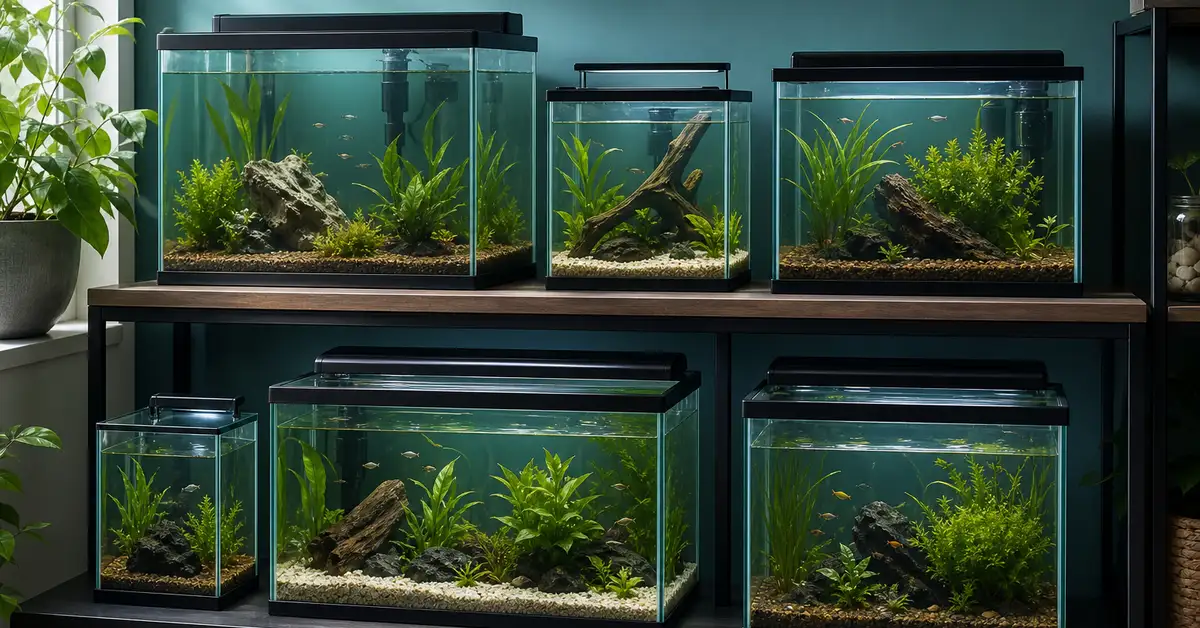
Why bigger is more forgiving, not harder
This is the single most counterintuitive fact in beginner fishkeeping, and it’s worth internalizing before you shop: a larger volume of water dilutes waste and stabilizes temperature far more effectively than a small one. In a 2-gallon tank, a little extra food or a missed water change can spike ammonia dangerously within a day; in a 20-gallon tank, the same mistake barely registers. Aquarium Co-Op’s community guidance is consistent on this point — the “start small to learn” instinct many beginners have is backwards, since a small tank actually demands more precise, more frequent maintenance to stay stable, not less.
Size-by-size breakdown
Nano (1-5 gallons): the smallest realistic option, suited to a single betta, a light shrimp colony, or a nano planted display. Least forgiving of the sizes here — water parameters swing fastest, and daily attention matters more. See our nano & 5-gallon tanks guide for picks and the stability trade-offs in more depth.
10 gallons: a genuinely reasonable, compact first tank — small enough for most furniture and budgets, large enough to support a modest community (a small school of tetras or corydoras, or a single betta with room to spare). See our best 10-gallon tanks guide.
20 gallons (especially “20-long”): widely cited as the beginner sweet spot. A 20-long’s extra floor footprint (rather than a taller “20-high”) gives more usable swimming and surface area for the same volume, which matters for oxygen exchange and stocking capacity. Meaningfully more forgiving than a 10-gallon while still fitting most rooms without special floor considerations.
29-40 gallons: a genuine step up in stocking flexibility and stability, popular with beginners who’ve done some research and want room to grow into a larger community without an immediate second upgrade. Weight and floor loading start to matter more at this range, especially on upper floors.
55+ gallons: excellent stability and stocking flexibility, but a real commitment in cost, floor loading and physical footprint. Worth it if you’re confident in the hobby and have the space and budget; overkill as a first tank for most beginners.
The “inch per gallon” rule is a starting point, not a real answer
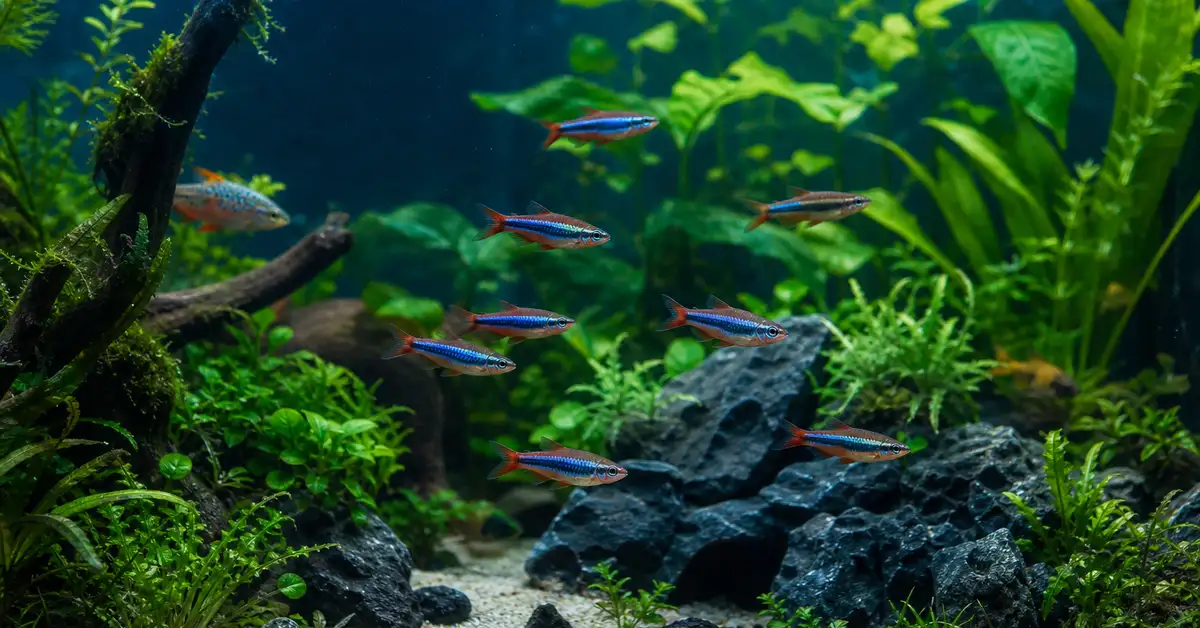
You’ll see “1 inch of fish per gallon” everywhere, but it’s a rough beginner shortcut that ignores body shape, waste output and swimming behavior — a single chunky 4-inch goldfish is nothing like four slim 1-inch tetras. A more accurate approach used by experienced aquarists is a surface-area rule: roughly 12 square inches of water surface per inch of adult fish length for typical community species, since oxygen exchange happens at the surface, not through the whole water column. A 20-gallon long (30″ × 12″ footprint = 360 sq in of surface) comfortably supports around 30 inches of small community fish under that rule — noticeably more generous than a taller tank of the same gallon volume with less surface area. Free tools like AqAdvisor-style stocking calculators can help you sanity-check a specific stocking plan against your actual tank dimensions and filtration.
Weight and floor loading: a real practical constraint
Water alone weighs about 8.34 lbs per US gallon, before adding the tank, stand, substrate, rock and equipment — a fully set-up 75-gallon tank can weigh 800+ lbs, and a 120-gallon setup can approach 1,100-1,500 lbs. Residential floors are typically rated for around 40 lbs per square foot of live load, and a large tank concentrates weight onto a comparatively small footprint, which is why placement against a load-bearing wall (or a structural engineer’s input for 90+ gallon setups) becomes a genuine consideration as size increases. For most beginner sizes (up to about 40-55 gallons) on a ground floor, this isn’t a serious concern, but it’s worth knowing the numbers before committing to a very large tank, especially on an upper floor.
Cost and maintenance time scale with size too
A larger tank costs more upfront (the tank itself, a stand rated for the weight, a bigger heater and filter, more substrate) and each individual water change takes longer in absolute time, even though it’s needed less often relative to the mistakes it forgives. In practice, most beginners find a mid-size tank (10-20 gallons) a reasonable balance: meaningfully more forgiving than a nano tank, without the cost and physical commitment of a 40+ gallon setup.
How to actually decide
Start with your available space and realistic budget — both the tank itself and everything it needs (filter, heater, light, substrate; see our kits hub for bundled options at several sizes). Within that constraint, default to the largest tank your space and budget genuinely support, since stability is the biggest favor you can do yourself as a beginner. If you specifically want a single betta or a small shrimp colony and space is very limited, a well-chosen nano tank (5 gallons rather than 1-2) is a reasonable, deliberate choice rather than a compromise — just go in understanding the closer attention it needs. If you’re drawn to a wide community of small schooling fish, size up toward 20 gallons or beyond if you can.
What we can’t verify
Weight figures and stocking guidelines above are drawn from industry calculators and aquarist community consensus rather than our own measurements of every specific tank and stand combination — always check your specific tank and stand’s actual filled weight and your floor’s load rating for anything above about 40-55 gallons.
Frequently Asked Questions
General information only — not veterinary advice. If your fish show signs of stress or illness, consult an aquatic veterinarian.
Sources: Aquarium Co-Op: New Fish Checklist · Aquarium Co-Op: How Many Fish Can I Put in a Fish Tank? · Aquarium Co-Op Forum: Beginner Starting Out, 20g or 40g? · Aqua Custom Fish Tanks: Aquarium Weight & Structural Load Calculator · AquariumCalc: Aquarium Weight Calculator