Short answer: a hang-on-back (HOB) filter is the pragmatic default for most 10-70 gallon community tanks; a canister filter earns its extra cost and complexity once you’re past about 75 gallons or keeping messy, high-bioload fish like goldfish or large cichlids; and a sponge filter is the safest, gentlest choice for nano tanks, bettas, shrimp, fry and breeding or quarantine setups. None of the three is universally “best” — each is a different engineering approach to the same job, and the right pick depends on your tank size, livestock and how much maintenance complexity you’re willing to take on.
How we researched this comparison
Last updated September 2026 — the mechanical detail, flow data and maintenance guidance below were checked against current manufacturer and aquarist-education sources this month; nothing here has changed since the original comparison. This isn’t a ranked product roundup — there’s no single “winner” between filter types, only better and worse fits for a given tank. We pulled mechanical detail, flow and turnover data, media guidance and maintenance framework from manufacturer documentation and established aquarist education sources (Aquarium Co-Op, Fishkeeping World, Fishkeeper.co.uk, LiveAquaria, AquariumScience.org, Bulk Reef Supply), and we’ve flagged which claims are attributed opinion (like “canister filters are quiet”) versus mechanical fact. Full method: How We Choose.
Quick comparison
| Type | How it works | Best for | Flow control | Media capacity | Maintenance | Price band |
|---|---|---|---|---|---|---|
| Canister | External pump draws water through stacked media trays, returns via hose | 75+ gal, messy/heavy-bioload fish | Adjustable via intake/output valves | Largest — mechanical + biological + chemical | Less frequent, more involved (weeks to months) | $$-$$$$ |
| HOB | Rim-mounted box; lift tube + impeller pushes water through a cartridge, returns as a waterfall | 10-70 gal community tanks | Adjustable on some models | Moderate — cartridge or foam-based | Frequent but quick (weekly-monthly) | $-$$ |
| Sponge | Air pump drives bubbles up a tube, drawing water through submerged foam | Nano tanks, bettas, shrimp, fry, breeding/quarantine | Adjustable via air pump/air stone | Combined mechanical + biological, no chemical stage | Simple, but bacteria-sensitive (monthly or by feel) | $ (plus a separate air pump) |
Canister filters
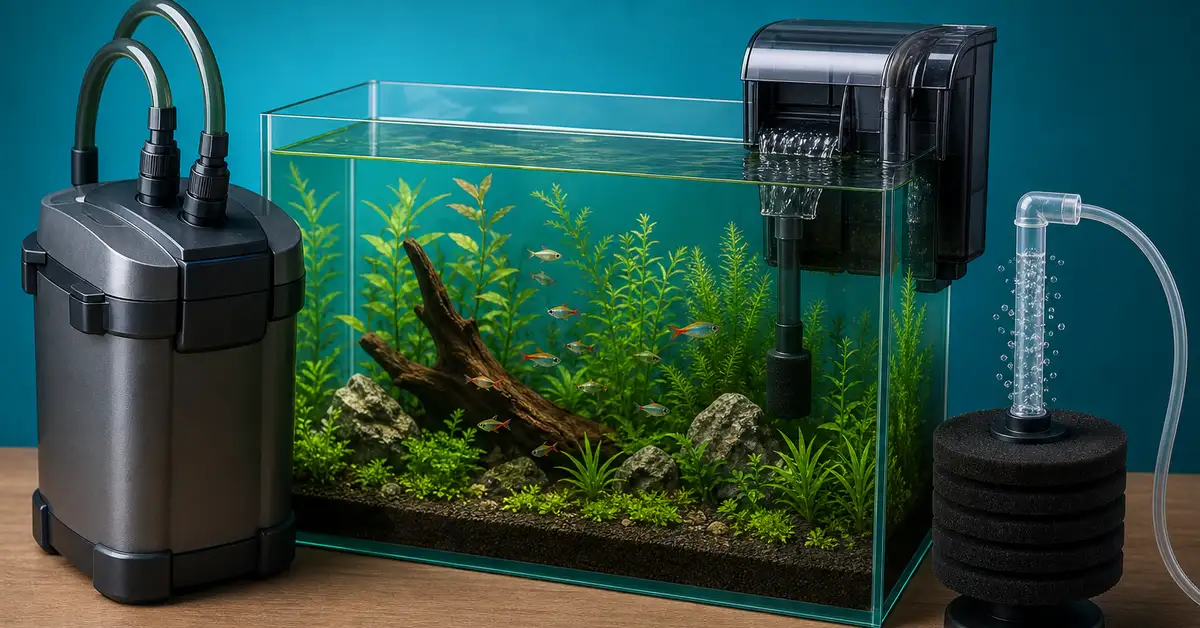
A canister filter sits outside the tank — usually in the cabinet below — and pulls water through intake hoses into an external chamber, where a powered impeller pushes it through several stacked trays of media before returning it via an output hose. Fishkeeping World and Fishkeeper.co.uk both describe this as the highest-capacity mainstream filter design, with Fishkeeper.co.uk noting external filters “really come into their own” on tanks of 200 liters (roughly 50+ gallons) and up.
Flow and adjustability: canisters are commonly rated between roughly 200 and 700 GPH before media is added, but AquariumScience.org notes that filling the canister with media and running the hose up to the tank typically cuts real-world flow by about half — so the printed number overstates what actually reaches your aquarium. Intake and output valves let you throttle flow for gentler-flow species, and spray bars can spread the return to avoid a single hard jet.
Media capacity: this is the canister’s biggest structural advantage — enough internal volume for genuinely separate mechanical, biological and chemical stages. AquariumScience.org’s testing found that coarse foam or plastic pot scrubbers substantially outperform the ceramic rings and bioballs many canisters ship with, for biological surface area specifically — a detail worth knowing before you assume the bundled media is optimal.
Maintenance: less frequent than HOB or sponge, but more involved. One commonly cited schedule (Complete Koi) is every 2-4 weeks depending on bioload; AquariumScience.org notes that a canister run mostly as a biological filter on coarse foam, with minimal fine mechanical media, can go as long as six months between full services. Every source agrees on one point: rinse media in tank water pulled during a water change, never under the tap, and stagger biological media replacement rather than swapping it all at once — see our fishless cycling guide if you want the full reasoning behind why that matters.
Noise: Fishkeeping World and Fishkeeper.co.uk both describe canisters as very quiet or “virtually silent” — but this is an attributed, experiential claim from each source, not a measured decibel comparison. The real mechanism: a submerged return avoids the splashing a HOB waterfall creates, so canisters are quieter by design, though incomplete priming (trapped air hitting the impeller) or a dirty impeller can still cause rattling or grinding.
Common mistakes: not fully priming after cleaning (causes airlock, noise and reduced flow), replacing all media at once (destabilizes the bacterial colony), and neglecting impeller cleaning (roughly every six months, per Complete Koi’s guidance). See our filter cleaning guide for the full process. Want specific canister picks? See our best canister filters guide.
HOB (hang-on-back) filters
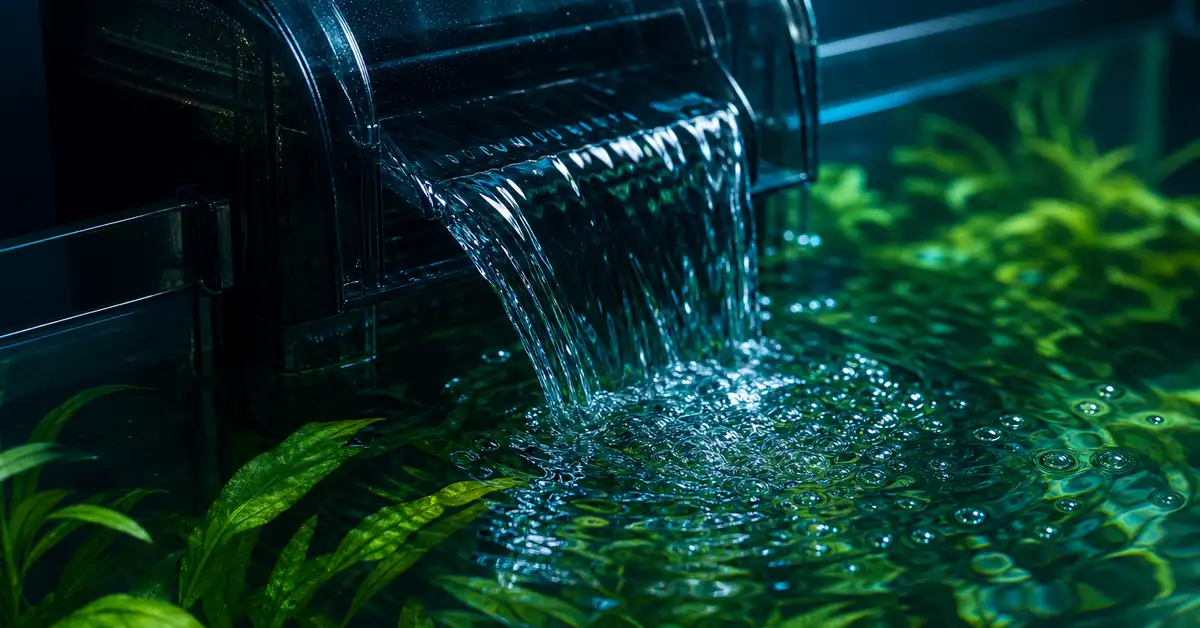
A HOB filter hangs off the back rim of the tank: an intake tube draws water up into a box, where it passes through a cartridge or foam media before spilling back into the tank over a lip — the characteristic “waterfall” return. Fishkeeping World calls this the most common filter type for small tanks, citing low cost and easy top-access maintenance as the main draw.
Flow and adjustability: typical HOB models range from about 20 to 300+ GPH. As one manufacturer example, Hygger rates a 5W model at 132 GPH for 10-30 gallon tanks and a 10W model at 264 GPH for 30-70 gallon tanks — both landing in the commonly-recommended 4-9x turnover range. Many models include a flow dial or slider, though a clogged cartridge can silently cut effective flow well below what the label promises.
Media capacity: smaller than a canister’s. The stock setup is usually a disposable cartridge combining floss and carbon, which manufacturers often suggest replacing monthly. AquariumScience.org pushes back hard on that guidance, arguing cartridges can be cleaned and reused for years and should only be discarded when they physically fall apart — full monthly replacement removes bacteria that took weeks to establish. A common upgrade: swap the cartridge for a foam block, and add a foam pre-filter sponge over the intake to protect fry and shrimp while adding more biological surface area.
Maintenance: quick and accessible — media lifts out from the top in minutes, which is exactly why HOB filters are the beginner-friendly default. Typical rinse/clean intervals run one to a few weeks depending on stocking, always in tank water rather than tap water.
Noise: the defining sound is the waterfall itself, not the motor — water splashing back over the lip. Fishkeeper.co.uk and LiveAquaria both note this is louder when the tank’s water level sits further below the return lip, so keeping the water line high measurably quiets a HOB down. Some aquarists like the ambient trickle; others find it intrusive — it’s a genuine trade-off, not a flaw.
Common mistakes: discarding cartridges monthly on manufacturer schedule (removes bacteria unnecessarily), letting intake strainers clog with algae or debris, and running a low water level that maximizes splash noise. Every HOB pick in our general roundup is covered in the best aquarium filters hub.
Sponge filters
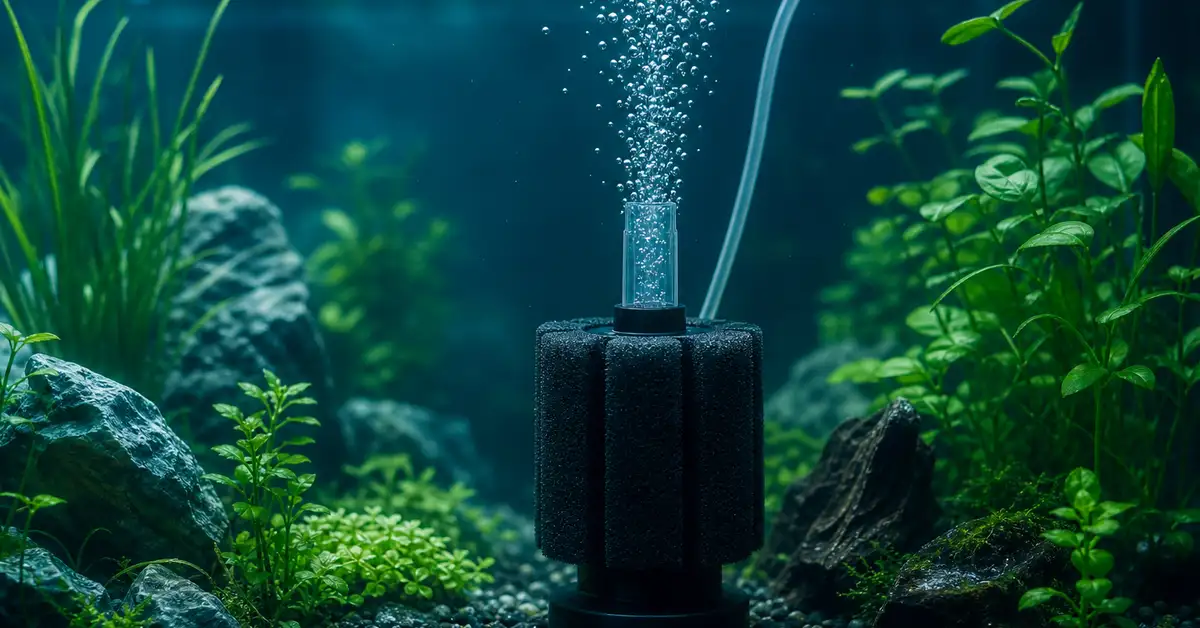
A sponge filter has no motor of its own: a separate air pump pushes air through tubing into an uplift tube inside a submerged foam cylinder, and the rising bubbles draw water through the sponge’s pores by suction. Aquarium Co-Op describes the whole system as just three parts — sponge, air pump, and airline tubing — making it the mechanically simplest option here.
Flow and adjustability: flow isn’t GPH-rated the way powered filters are; it’s a function of air pump strength, bubble size and sponge size. AquariumScience.org notes sponge filters rarely hit 4x+ turnover in anything but a small tank, which is part of why they suit gentle-flow livestock so well. Aquarium Co-Op recommends fitting an air stone inside the sponge to convert large, intermittent “elevator” bubbles into a smaller, steadier stream — quieter and more effective at driving flow.
Media capacity: the sponge itself does double duty as mechanical and biological media in one piece — there’s no dedicated slot for chemical media (carbon, resin) at all. AquariumScience.org draws a useful distinction between two ways to run one: clean it weekly and it behaves mostly as a mechanical filter, or clean it lightly every couple of months and it becomes a genuinely strong biofilter — you can’t fully optimize for both at once.
Maintenance: simple mechanically, but the most bacteria-sensitive of the three. Aquarium Co-Op’s guidance: squeeze and wring the sponge in a bucket of water taken from your own tank — never tap water — roughly once a month or whenever bubble output visibly drops. We’d flag one thing explicitly: some hobbyist forum threads suggest a diluted bleach soak for a badly clogged sponge; we don’t recommend this, since it strips the biofilter completely and requires re-seeding — old-tank-water rinsing is the safer, standard method and what we recommend across every filter type on this site.
Noise: no motor hum from the filter itself — all the sound comes from the external air pump and bubble activity. An air stone smooths large “plopping” bubbles into a steady fizz, and mounting the air pump on a soft mat or foam pad reduces vibration transmitted through furniture.
Tank size and livestock: this is where sponge filters clearly win. No powered intake means no suction risk to fry, shrimp or slow-moving fish — Fishkeeper.co.uk specifically calls out Siamese fighting fish (bettas) as beneficiaries of the gentle flow. Fishkeeper.co.uk also notes air-powered sponge filters generally aren’t capable of filtering tanks much beyond about 60cm (roughly 20-30 gallons) on their own. See our best sponge filters guide for specific picks, and our best betta filters roundup if you’re shopping specifically for a betta tank.
Which should you pick?
By tank size: for a nano tank under 5 gallons, a sponge filter is almost always the right call — gentle enough for the light bioload and small footprint. For 5-10 gallons, a sponge filter still works well, or a low-output HOB/internal filter with the flow throttled and an intake sponge fitted. For 20+ gallon community tanks, a HOB filter is the pragmatic default; once you’re past roughly 40-75 gallons, or running a heavier bioload, a canister starts to make more sense for its media capacity and quieter submerged return.
By livestock: bettas, shrimp, fry and other delicate or slow-moving species do best with a sponge filter, or a HOB/canister with flow reduced and the intake guarded by a foam pre-filter. General community fish (tetras, barbs, dwarf cichlids) are well served by a standard HOB. Messy or high-bioload fish — goldfish, larger cichlids — benefit most from a canister’s mechanical and biological capacity.
By budget: a sponge filter plus air pump is the cheapest way in, though a decent air pump adds real cost to what looks like a budget option on paper. HOB filters sit budget-to-mid, and you can keep running costs low by cleaning and reusing cartridges (or swapping to foam) instead of buying monthly replacements. Canisters cost more upfront and their bundled media can be pricier to replace on schedule — but switching to generic coarse foam or pot scrubbers, as AquariumScience.org suggests, can bring long-term costs down closer to a HOB’s.
Combining types: you don’t have to pick just one. A sponge filter for biological stability alongside a HOB or canister for mechanical polishing and occasional carbon use is a common, sensible hybrid — especially useful when moving fry or shrimp between tanks, since a mature sponge filter can be relocated to instantly seed a new setup.
Frequently Asked Questions
General information only — not veterinary advice. If your fish show ongoing signs of stress after a filter change, consult an aquatic veterinarian.
Sources: Aquarium Co-Op: Fish Tank Filters, Which One Should You Get? · Aquarium Co-Op: Sponge Filters · Fishkeeping World: Best Aquarium Filter Guide · Fishkeeper.co.uk: Choosing an Aquarium Filter · LiveAquaria: Choosing the Proper Flow Rate · AquariumScience.org: Canister Filters · AquariumScience.org: Hang-on-the-Back Filters · AquariumScience.org: Sponge Filters · Bulk Reef Supply: Filter Media Explained