The best aquarium filter depends on your tank size and how much maintenance you want to take on: hang-on-back (HOB) filters like the Fluval AquaClear line suit most 10-50 gallon freshwater tanks, canister filters like the Fluval FX4 or EHEIM Professionel 5e take over for 75+ gallon or heavily-stocked setups, sponge filters cover fry and shrimp tanks, and internal power filters work well in small or leak-averse setups. We researched 12 real, currently-sold filters across all four types by tank size, flow rate and media capacity — here’s the honest breakdown.
How we chose these filters
We’re not a testing lab — Honest Aquarium is written by a real fishkeeper doing real research, not a bench of hardware. For this hub we started from manufacturer spec sheets (flow rate in GPH, recommended tank size, media type and capacity, priming mechanism for canisters), cross-checked against independent aquarist editorial including Aquarium Co-Op, Fishkeeping World and owner-review signal from Chewy and major retailers. Every filter was checked against current US Consumer Product Safety Commission recall notices before inclusion. Full method: How We Choose.
Last updated July 2026 — all 12 picks below are confirmed still sold as of this year, spanning hang-on-back, canister, sponge and internal filters from nano tanks up to 250-gallon setups.
New to filtration or fishkeeping generally? Start with our betta fish care guide or our water parameters reference — and remember that every filter here needs its media colonized with bacteria before fish go in; see our guide to cycling a fish tank. Already have a filter installed? See our guide to cleaning an aquarium filter the right way, without harming your cycle. Not sure which filter type is right for your tank? Our canister vs HOB vs sponge comparison breaks down the trade-offs honestly. Shopping for the tank itself? See our best aquarium kits for beginners hub.
Quick comparison
| Filter | Type | Best for | Tank size | Price band |
|---|---|---|---|---|
| 1. Fluval AquaClear 50 | HOB | Best overall | 20-50 gal | $25–75 |
| 2. Seachem Tidal 110 | HOB | Best for large tanks | Up to 110 gal | $75–150 |
| 3. Fluval AquaClear 30 | HOB | Best for small/mid tanks | 10-30 gal | $25–75 |
| 4. Aqueon QuietFlow LED PRO 50 | HOB | Best budget HOB | Up to 50 gal | $25–75 |
| 5. Tetra Whisper IQ 45 | HOB | Best quiet HOB | Up to 45 gal | $25–75 |
| 6. Marineland Penguin 350 | HOB | Best Bio-Wheel HOB | Up to 75 gal | $25–75 |
| 7. Fluval FX4 | Canister | Best for large tanks | Up to 250 gal | $300–700 |
| 8. Penn-Plax Cascade 1000 | Canister | Best value canister | Up to 100 gal | $75–150 |
| 9. EHEIM Professionel 5e | Canister | Best premium canister | Mid-to-large | $300–700 |
| 10. Aquarium Co-Op Coarse Sponge Filter | Sponge | Best sponge filter | Nano to large | under $25 |
| 11. Tetra Whisper 20i | Internal | Best internal, small/mid | 10-30 gal (per Amazon listing, a secondary source) | $25–75 |
| 12. Finaqua Submersible Filter | Internal | Best internal, large tanks | 10-75 gal | Band not confirmed: check the listing |
The 12 best aquarium filters (2026)
Transparency first: This guide contains affiliate links. If we’re enrolled in an affiliate program, we may earn a commission at no extra cost to you — it never affects how we research or rank. Read our full affiliate disclosure policy.
1. Fluval AquaClear 50 Power Filter — Best Overall
Fluval’s AquaClear series is one of the most consistently recommended hang-on-back filter lines in the hobby, and the 50 model is the sweet spot for the 20-50 gallon tanks most beginners start with. Its defining feature is filtration volume up to seven times larger than comparable cartridge filters, giving beneficial bacteria far more surface area and far more contact time between water and media than a slim cartridge design allows.
Best for: beginners and intermediate keepers who want a customizable, widely-praised HOB filter for a 20-50 gallon community tank.
Key specs: 20-50 US gal · hang-on-back · modular media basket (foam, activated carbon, Biomax ceramic rings) · filtration volume up to 7× comparable filters.
Pros: fully customizable media (swap carbon for extra biological media, add filter floss), generous internal volume, decades-long track record.
Cons: manufacturer doesn’t publish an exact GPH figure for this size in its public specs; waterfall noise increases if tank water level drops, so keep the water line close to the spillway.
Price band: $25–75 · Evidence: Chewy owner reviews of the AquaClear 50 highlight its “sleek design” and generous space for custom media; independent editorial roundups (Fishkeeping World, TropicalFishCareGuides) consistently name the AquaClear line among the most-recommended HOB filters in the hobby. No CPSC recalls associated with this product line.
2. Seachem Tidal 110 — Best for Large Tanks
Seachem’s Tidal line represents the modern take on hang-on-back filtration, and the largest model in the range is rated for aquariums up to 110 US gallons — a size that once would have pushed most owners toward a canister. It pairs a 450 US GPH flow rate with a substantial 0.85-gallon media volume and a surface skimmer intake that pulls in floating debris and biofilm alongside the main water draw.
Best for: owners of large, moderately-stocked community tanks who want HOB simplicity instead of canister complexity.
Key specs: up to 110 US gal · 450 US GPH · 0.85 gal media volume · self-priming pump · surface skimmer intake.
Pros: self-priming (restarts automatically after a power cut, no manual refilling), large media basket, surface skimming reduces biofilm buildup.
Cons: at full flow, 450 GPH is a strong current best suited to large or heavily planted tanks — dial it back for calmer-water species.
Price band: $75–150 · Evidence: manufacturer specs confirmed on Seachem’s own Tidal comparison page; independently reviewed as a top HOB pick by ModestFish’s hands-on Tidal review, and frequently compared favorably against the AquaClear line in third-party roundups. No CPSC recalls associated with this product line.
3. Fluval AquaClear 30 Power Filter — Best for Small-to-Mid Tanks
The smaller sibling to our top pick, the AquaClear 30 brings the same customizable-media philosophy to 10-30 gallon tanks — the range most 10, 20 and 29-gallon starter setups fall into. At 150 US GPH on a 20-gallon tank, it delivers roughly 7.5 turnovers per hour, comfortably within the range most expert sources recommend for beginner community tanks.
Best for: 10-30 gallon beginner tanks where flexible media and a proven track record matter more than premium features.
Key specs: 10-30 US gal · 150 US GPH · modular media basket (foam, carbon, Biomax ceramic rings) · adjustable flow.
Pros: same generous filtration volume as the AquaClear 50 in a smaller footprint, adjustable output for calmer-water fish, easy to customize.
Cons: 150 GPH on a 10-gallon tank is a brisk 15× turnover — turn the flow control down or baffle the outlet for skittish or long-finned species.
Price band: $25–75 · Evidence: manufacturer specs verified on Fluval’s own product pages; consistently recommended alongside the AquaClear 50 in independent HOB roundups. No CPSC recalls associated with this product line.
4. Aqueon QuietFlow LED PRO Size 50 — Best Budget HOB
Aqueon’s QuietFlow LED PRO line trades some of the AquaClear’s media flexibility for out-of-the-box convenience: a self-priming pump, multi-stage cartridge filtration, and an LED indicator that lights up when flow drops enough to signal a cartridge change — useful for beginners who might not otherwise notice a slowly clogging filter.
Best for: budget-conscious beginners who want a simple, cartridge-based filter with a built-in maintenance reminder.
Key specs: up to ~50 US gal · multi-stage cartridge (mechanical, chemical, biological) · self-priming pump · LED cartridge-change indicator.
Pros: genuinely simple to maintain, self-priming after power cuts, the LED indicator removes the guesswork on when to change media.
Cons: cartridge-based media is less customizable than an open basket design like the AquaClear; manufacturer doesn’t publish an exact GPH figure in its public listing.
Price band: $25–75 · Evidence: long-standing mainstream brand with wide retail distribution; cartridge-indicator design aligns with AquaticExperts’ general guidance that HOB filters suit beginners who want simple, low-maintenance filtration. No CPSC recalls associated with this product line.
5. Tetra Whisper IQ 45 Power Filter — Best Quiet HOB
Tetra’s Whisper IQ series is built around noise reduction and straightforward cartridge maintenance, with flow scaling clearly by model: the IQ 20, 30 and 45 are rated at 130, 175 and 215 GPH respectively. At 215 GPH on a 40-gallon tank, the IQ 45 delivers about 5.4 turnovers per hour — solid, unspectacular performance aimed squarely at community tanks in bedrooms and living rooms where a quiet filter matters.
Best for: mid-size community tanks in noise-sensitive rooms, and beginners who prefer Tetra’s cartridge-based simplicity.
Key specs: ~40-45 US gal · 215 US GPH (IQ 45 model) · cartridge-based mechanical + chemical media · noise-reduction housing.
Pros: genuinely quiet operation, adjustable flow, well-known brand with broad retail availability.
Cons: cartridges limit media customization compared with open-basket designs like AquaClear; biological capacity is more modest than filters built around ceramic ring media.
Price band: $25–75 · Evidence: flow-rate specs confirmed on Tetra’s own product page; Tetra’s long-standing presence in beginner fishkeeping is repeatedly cited across independent buying guides. No CPSC recalls associated with this product line.
6. Marineland Penguin 350 Power Filter — Best Bio-Wheel HOB
Marineland’s Penguin Bio-Wheel filters have been a fixture of North American fishkeeping for decades. The Penguin 350’s namesake Bio-Wheel is a rotating biological wheel that sits in the filter’s outflow, exposing beneficial bacteria to both water and air — a design that keeps a visible biological colony intact even when mechanical cartridges are swapped out, addressing one of the classic downsides of cartridge-based HOB filters.
Best for: 55-75 gallon tanks where owners want HOB simplicity plus a biological safety net against over-eager cartridge changes.
Key specs: up to ~75 US gal · nominal ~350 GPH · Rite-Size C cartridges · rotating Bio-Wheel biological media · noise-reducing vented cover.
Pros: the Bio-Wheel preserves biological filtration even during cartridge changes, adjustable mid-level intake strainer, decades of proven reliability.
Cons: cartridge-reliant mechanical/chemical stage encourages some owners to over-replace media — rinse and reuse when possible rather than discarding on every change.
Price band: $25–75 · Evidence: specs confirmed via The Hidden Reef’s product listing; Bio-Wheel technology has decades of hobbyist track record as a large-tank HOB workhorse. No CPSC recalls associated with this product line.
Canister filters: for large or heavily-stocked tanks
Want the full canister breakdown, including EHEIM, SunSun and Marineland options? See our dedicated guide to the best canister filters, spec-verified against manufacturer data.
7. Fluval FX4 Canister Filter — Best for Large Tanks
The FX4 is Fluval’s flagship canister for serious freshwater setups, rated for aquariums up to 250 US gallons at a substantial 700 US GPH. Its Smart Pump microchip continuously monitors and adjusts pump performance and purge cycles, reducing the manual troubleshooting that older canister designs demanded.
Best for: large, heavily-stocked or messy tanks (big cichlids, goldfish, large planted setups) where a HOB filter would be undersized.
Key specs: up to 250 US gal · 700 US GPH · multi-stage media trays · Smart Pump electronic monitoring · valved hose connectors with purge valve.
Pros: enormous media capacity for mechanical, biological and chemical stages, electronically assisted priming, purge valve simplifies water changes.
Cons: significantly more setup and maintenance complexity than a HOB filter — hose management and periodic full disassembly are non-negotiable parts of ownership.
Price band: $300–700 · Evidence: manufacturer specs confirmed on Fluval’s own FX4 product page; named among top-tier canister options by Charterhouse Aquatics’ canister filter guide. No CPSC recalls associated with this product line.
8. Penn-Plax Cascade 1000 Canister Filter — Best Value Canister
The Cascade 1000 delivers genuine canister-filter capability — multiple stacked media baskets, 265 US GPH, and a manual push-button primer — at a noticeably lower price than premium European or high-end Fluval canisters, making it a realistic entry point for beginners ready to move up from a HOB filter.
Best for: 55-100 gallon tanks where an owner wants canister-level media capacity without a premium price tag.
Key specs: up to 100 US gal · 265 US GPH · multiple stacked media baskets · push-button manual primer.
Pros: strong capacity-to-price ratio, individually removable media baskets simplify targeted cleaning, widely available.
Cons: manual priming is an extra step compared with self-priming or electronically-assisted canisters; hose clamps and connections still demand careful handling to avoid leaks.
Price band: $75–150 · Evidence: flow rate and tank-size specs confirmed on the manufacturer listing; positioned by aquarist guides as a value-oriented alternative to premium canister brands. No CPSC recalls associated with this product line.
9. EHEIM Professionel 5e Canister Filter — Best Premium Canister
EHEIM is one of the most respected names in aquarium filtration, and the Professionel 5e series represents its current flagship canister technology: electronic flow control, integrated maintenance timers, and energy-optimized pumps built on decades of German engineering.
Best for: committed hobbyists with large or high-bioload tanks who want the most reliable, longest-lived canister option available.
Key specs: mid-to-large tank range · electronic flow control · multi-tray customizable media baskets · integrated maintenance timer · energy-optimized pump.
Pros: exceptional build quality and seal reliability, precise electronic flow adjustment, maintenance timer helps prevent neglected cleanings.
Cons: premium pricing puts it out of reach for many beginners; manufacturer doesn’t publish a single GPH figure across the range since it varies by model.
Price band: $300–700 · Evidence: named a leading modern canister option by Charterhouse Aquatics’ 2025/2026 canister filter guide, which specifically highlights EHEIM’s reputation and the 5e line’s technology. No CPSC recalls associated with this product line.
Sponge and internal filters: gentle flow and specialty roles
Looking specifically for a betta, fry or shrimp-safe sponge filter? See our dedicated guide to the best sponge filters, spec-verified against manufacturer and retailer data.
10. Aquarium Co-Op Coarse Sponge Filter — Best Sponge Filter
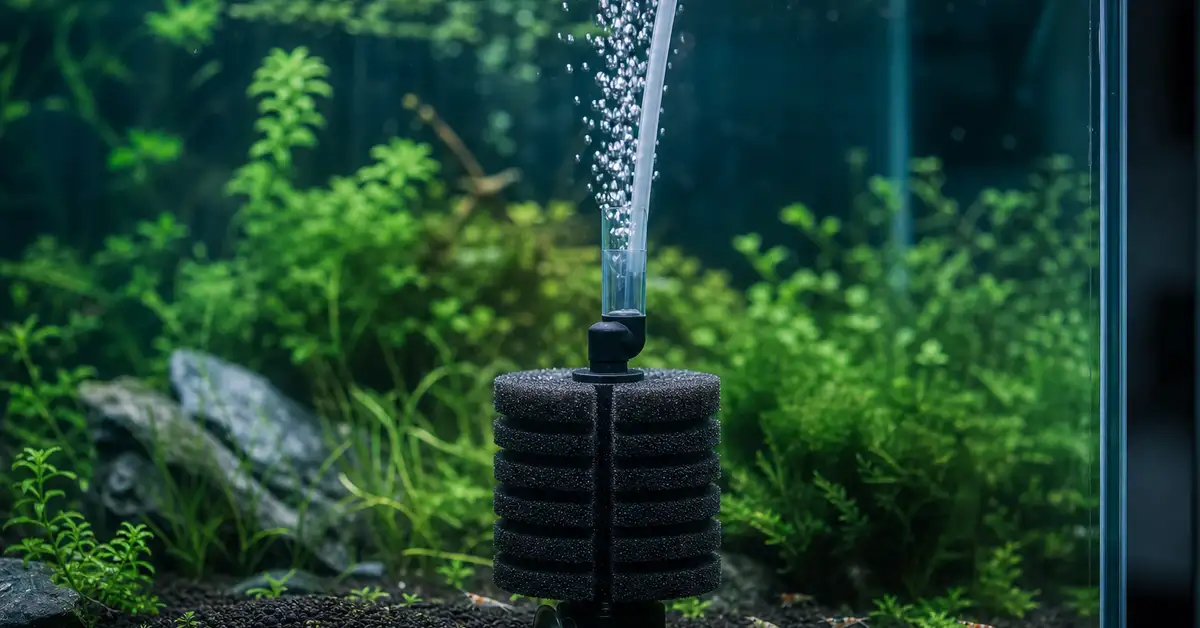
Aquarium Co-Op’s coarse sponge filters are among the most widely discussed sponge filters in the modern hobby: large-pored foam that resists clogging, a weighted base that won’t tip or float, and green plastic that disguises the algae growth every sponge filter eventually gets. Air-driven rather than pump-driven, they provide gentle, fry-safe and shrimp-safe flow alongside a large biological surface area.
Best for: breeding and fry-grow-out tanks, shrimp tanks, quarantine setups, or as backup biological filtration alongside a power filter or canister.
Key specs: nano to large tank sizes (model-dependent) · air pump-driven (requires separate air pump + airline) · coarse foam · weighted base.
Pros: gentlest flow of any filter type here, large biofilm surface area, inexpensive, provides redundant biological filtration if a power filter fails.
Cons: minimal mechanical polishing compared with HOB or canister filters — rarely the sole filtration in a display tank over about 20-30 gallons; needs a separate air pump.
Price band: under $25 · Evidence: Aquarium Co-Op (one of the hobby’s most-cited educational sources) publishes both the product listing and a detailed filter-cleaning guide covering sponge-filter maintenance specifically. No CPSC recalls associated with this product line.
11. Tetra Whisper 20i Internal Power Filter — Best Internal Filter, Small/Mid Tanks
Tetra’s Whisper internal filter range sits inside the tank, held by a clip on the tank wall, so the filter body mounts inside the aquarium. Tetra rates the 20i at 125 GPH, in the middle of a range that runs from the 20-GPH 3i to the 170-GPH 40i. Tetra sells the Whisper internal filter in a 10-30 gallon size, and the linked Amazon listing (a secondary source; Tetra model 25817) names the 20i as that size.
Best for: 10-30 gallon tanks (the size the Amazon listing, a secondary source, gives for the 20i) where owners want the filter inside the tank rather than hung on the rim.
Key specs: 10-30 US gal (size per the Amazon listing, a secondary source) · 125 US GPH (Tetra’s published figure; the Amazon listing title, a secondary source, says 135) · submersible, clip-mounted inside the tank · 3-stage: Bio-Bag cartridge (floss + activated carbon) plus a Bio-Scrubber biological stage.
Pros: the filter body stays inside the tank; the clip adjusts to high or low water levels; three filtration stages in one unit.
Cons: the unit takes up space inside the aquarium; flow figures differ between sources (Tetra publishes 125 GPH; the Amazon listing title, a secondary source, says 135), so size by the tank range rather than the GPH figure.
Price band: $25–75 · Evidence: flow rates and mounting from Tetra’s Whisper i product page, read 2026-09-27; model number and tank size from the linked Amazon listing (secondary), read 2026-09-27. No recalls found for the Tetra brand in the CPSC recalls database.
12. Finaqua Submersible Aquarium Filter — Best Internal Filter, Large Tanks
Tetra’s largest Whisper internal filter is sized for 20-40 gallon tanks, which is where the Finaqua internal filter stands out: Finaqua’s listing for the linked model (DSW-001, sold as the no-UV “20-75gal” size) calls it suitable for 10-75 gallon aquariums and says it performs best in 10-55 gallon fish and turtle tanks. It combines filtration, wave making, aeration and water changing in one unit.
Best for: larger fish tanks and turtle tanks where owners want a submersible filter instead of external canister equipment.
Key specs: 10-75 US gal per the listing (best in 10-55) · internal/submersible, snap-on clips · multi-stage sponge filtration, bottom to top · filtration, wave making, aeration and water changing · no UV lamp on this variant.
Pros: listed for tanks up to 75 gallons, past the 20-40 gallon top of Tetra’s Whisper internal range; compact internal design with snap-on clips; doubles as an aerator.
Cons: manufacturer doesn’t publish an exact GPH figure in its retail listing; the listing says it performs best in 10-55 gallon tanks, so read 75 gallons as the ceiling, not the target.
Price band: Band not confirmed: check the listing · Evidence: we could not confirm a current price for the exact variant linked here, so no band is shown. Specs are from Finaqua’s own Amazon store listing for model DSW-001, read 2026-09-27. No CPSC recalls found for the Finaqua brand.
What to avoid
Unbranded filters with no published specs. If a listing gives no flow rate, no recommended tank size, and no identifiable manufacturer, there’s nothing to spec-verify and no way to screen it against CPSC recalls — skip it regardless of price. Filters sized well below the tank’s actual volume are a common beginner mistake; an undersized filter struggles to keep up with bioload even when it’s technically “running.” Undergravel filters are a legacy technology that most modern expert guides no longer recommend as primary filtration for beginners — they’re prone to uneven flow and clog easily, and they conflict with planted-tank aquascaping.
How to choose the right filter for your tank size
For small tanks (5-10 gallons), both the AquaClear 30 and Tetra Whisper 10i/20i internal filters are solid starting points, alongside a nano Aquarium Co-Op sponge filter if you’re keeping shrimp, fry, or a betta that prefers gentler flow. For mid-size tanks (20-55 gallons), the AquaClear 50, Aqueon QuietFlow 50, Tetra Whisper IQ 45 and Penn-Plax Cascade 1000 all compete directly — HOB filters win on simplicity and lower upfront cost, while the Cascade 1000 wins on media capacity if you’re willing to take on canister maintenance. For large tanks (75+ gallons), Seachem’s Tidal 110 and Marineland’s Penguin 350 can carry moderately-stocked setups as HOB filters, but heavily-stocked or messy tanks (goldfish, large cichlids) generally do better with the mechanical and biological capacity of a canister like the Fluval FX4 or EHEIM Professionel 5e. Whatever you choose, a supplementary sponge filter adds cheap, redundant biological capacity in any size tank. Once it’s installed, keep it running well with our guide to cleaning an aquarium filter.
Frequently Asked Questions
General information only — not veterinary advice. If your fish show signs of stress or illness, consult an aquatic veterinarian.
Sources: Aquarium Co-Op: How to Clean Aquarium Filters · Aquatic Experts: Types of Aquarium Filters · Charterhouse Aquatics: Top-Rated External Canister Filters · Fishkeeping World: 5 Best HOB Filters · ModestFish: Seachem Tidal Filter, Tested & Reviewed · Seachem: Compare Tidal Filters · Fluval: FX4 Canister Filter · Fluval: AC Series Aquarium Filters · Tetra: Whisper IQ Power Filters · Tetra: Whisper i Internal Power Filter · Chewy: Fluval AC50 Power Filter Reviews · US CPSC: Recalls