Your heater’s built-in dial or display is not a thermometer — it’s a thermostat, and thermostats drift. The only way to actually know your tank’s temperature is an independent thermometer, checked regularly against it. We researched 10 real, currently-sold thermometers across every major type — stick-on, floating glass, digital probe, wireless smart, and infrared — and compared their manufacturer-published accuracy honestly, including where real-world testing shows more variance than the spec sheet suggests.
How we chose these thermometers
This is a specification-based selection: we pulled manufacturer accuracy claims (±0.5°F through ±2°F depending on type), measurement range, alarm/alert features, placement method and battery requirements directly from Fluval, Coralife, JBJ, Inkbird, REPTI ZOO and other manufacturer or retailer listings, then cross-checked against independent testing discussion on Reef2Reef and hobbyist review sites where it existed. What we can’t verify: we haven’t bench-tested these units ourselves against a lab-calibrated reference, and as you’ll see below, even manufacturer-published accuracy doesn’t always hold up in independent real-world comparisons — that’s exactly why we recommend checking any single thermometer against a second one rather than trusting one reading blindly. Full method: How We Choose.
Haven’t picked a heater yet? See our best aquarium heaters guide. Not sure what temperature to target? Our water parameters reference covers targets by species, and our temperature guide by fish type breaks it down species by species. Setting up a small first tank? Our best 10-gallon fish tanks guide covers sizing before you get to heating and temperature.
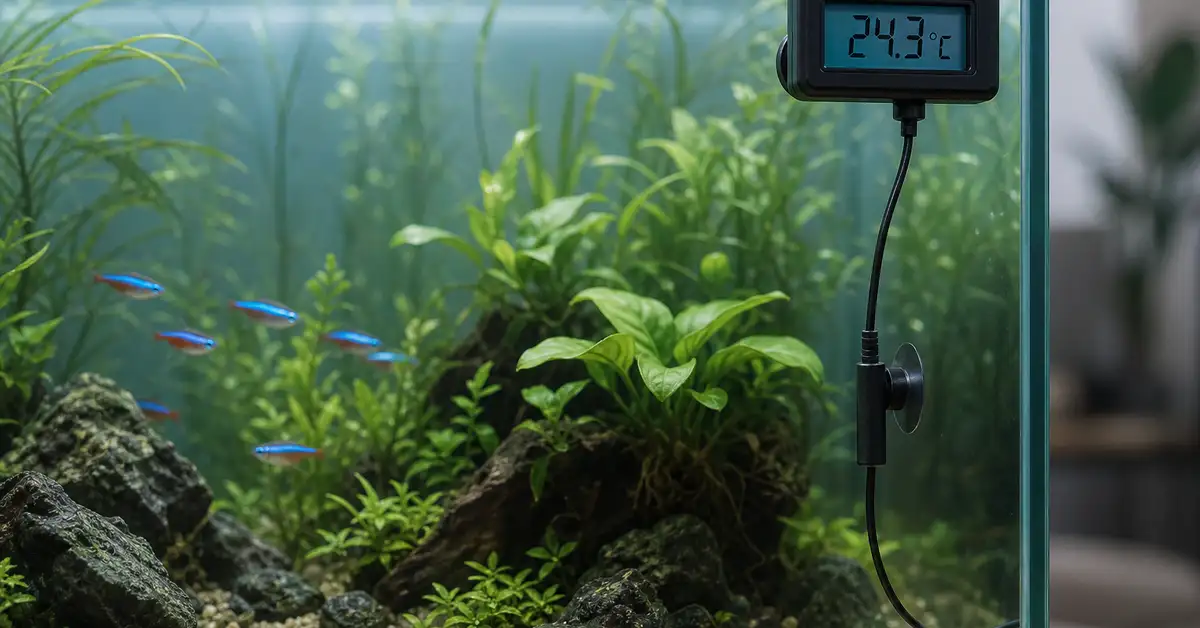
Why an independent thermometer matters
A heater’s thermostat is calibrated to switch the element on and off around a target — it is not designed or marketed as a precision temperature readout, and mechanical dials in particular can drift over months and years of use. Hobbyist consensus (echoed by manufacturer heater guidance) is to treat the heater’s dial as a rough control, and a separate thermometer as the actual source of truth. This matters doubly for the failure modes we covered in our heaters guide: a thermometer is often how you first notice a stuck-on or stuck-off heater, before it becomes a crisis. If you already suspect a problem, see our heater troubleshooting guide.
Worth knowing honestly: independent testing discussed on Reef2Reef has found that even name-brand digital thermometers don’t always agree with each other or with their own published accuracy spec — one comparison found two units of the same digital thermometer model disagreed with each other by nearly a degree Fahrenheit when tested side by side in the same water. The practical takeaway isn’t that any specific product is unreliable; it’s that no single thermometer should be treated as infallible. Cross-checking two independent readings (or a thermometer against your heater’s own display) is more reliable than trusting either alone.
Quick comparison
| Thermometer | Type | Claimed accuracy | Alerts? | Price band |
|---|---|---|---|---|
| 1. Marina LCD Stick-On | Adhesive LCD strip | General range, not precise | No | $ |
| 2. Fluval 2-in-1 Digital | Wireless external display | ±1°C (~2°F) | No | $$ |
| 3. Coralife Digital w/ Probe | Submersible probe + display | ±1.5°F (spec) | No | $$ |
| 4. Zacro Digital w/ Probe | Submersible probe + display | ±1°C | No | $ |
| 5. JBJ Digi-Temp | Submersible digital | ±1.5°F | No | $$ |
| 6. JBJ True Temp Controller | Digital controller + probe | ±0.5°F (spec) | Via controller | $$$ |
| 7. Floating Glass Thermometer | Analog liquid-filled glass | ±1°C (~1.8°F) | No | $ |
| 8. REPTI ZOO Dual-Probe Digital | Digital, 2 probes | ±2°F | No | $ |
| 9. Inkbird IBS-TH1 Plus | Wireless smart sensor + app | ±0.5°F (inner), ±1°C (probe) | Yes, app-based | $$ |
| 10. Infrared Laser Thermometer | Non-contact spot-check | ±2% / ±3.6°F | No | $ |
The 10 best aquarium thermometers (2026)
Transparency first: This guide contains affiliate links. If we’re enrolled in an affiliate program, we may earn a commission at no extra cost to you — it never affects how we research or rank. Read our full affiliate disclosure policy.
1. Marina LCD Stick-On — Best Budget At-a-Glance
This adhesive liquid-crystal strip mounts to the outside of the glass and shows a color-coded band (green for in-range, tan or blue for too warm or too cold) rather than a precise digital number. It’s the classic entry-level thermometer, and it’s genuinely useful for a quick glance — but it’s not designed for precision.
Best for: a cheap, always-visible general check, not as your only or most trusted reading.
Key specs: adhesive external mount · color-band range display (multiple temperature-range versions available) · no battery required.
Pros: inexpensive, no battery, always visible at a glance.
Cons: gives a range rather than a precise number, and readings can be skewed by room-side glass temperature rather than actual water temperature — don’t rely on this alone to judge whether your heater is working correctly.
Price band: $ · Evidence: manufacturer/retailer listings confirm color-band design; no recall found for this thermometer in our October 2026 CPSC search.
2. Fluval 2-in-1 Digital — Best for Comparing Room vs. Water Temperature
This wireless digital unit mounts to the outside of the tank and displays both water temperature (via a small external sensor) and ambient room temperature on the same LCD screen, without needing a probe wire run into the water. Being able to see both numbers side by side is genuinely useful for spotting when a cold room might be working against your heater.
Best for: aquarists who want a no-wire external display and like seeing room vs. tank temperature together.
Key specs: wireless external mount, no probe wire · displays water + room temperature · roughly ±1°C (~2°F) accuracy per manufacturer · single LR44 battery.
Pros: no messy probe wire, dual water/room readout is a genuinely useful comparison, easy to mount.
Cons: external, wireless sensing is inherently less precise than a submerged probe; treat it as a convenient secondary check rather than your most accurate reading.
Price band: $$ · Evidence: manufacturer FAQ and retailer listings confirm accuracy spec and dual-display feature; no recall found for this thermometer in our October 2026 CPSC search.
3. Coralife Digital with Probe — Best Widely-Used Value Pick
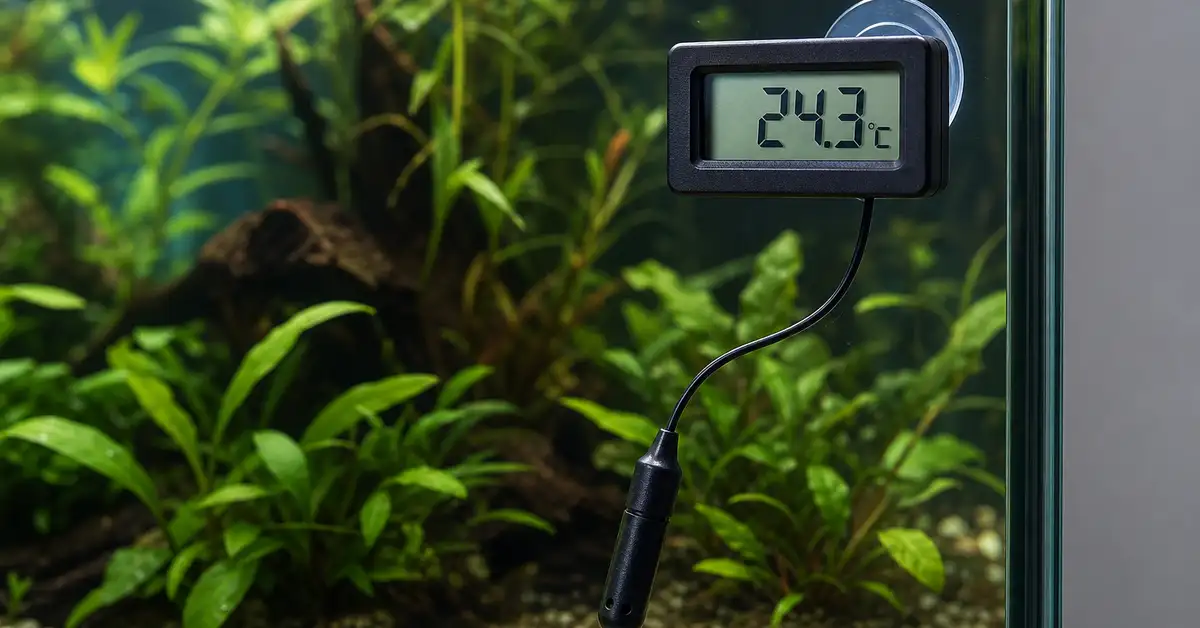
A submersible probe connected to an external digital display reading to a tenth of a degree, in a form factor that’s been a hobby staple for years. Manufacturer spec claims ±1.5°F accuracy. Honest disclosure: independent hobbyist testing discussed on Reef2Reef has found some inconsistency — in one comparison, this thermometer read consistently higher than a calibrated controller, and two units of the same model tested side by side in identical water disagreed with each other by roughly 0.7°F. We can’t independently verify how widespread this is, but it reinforces the point made above: use any single unit as one data point, not gospel.
Best for: aquarists who want a widely available, submersible-probe digital readout at a reasonable price, ideally checked against a second thermometer periodically.
Key specs: submersible probe + external display · reads to 0.1° · ±1.5°F manufacturer accuracy spec · range roughly -10°F to 140°F.
Pros: precise-looking tenth-of-a-degree display, submerged probe is more representative than external sensing, widely available.
Cons: independent testing suggests unit-to-unit variance can exceed the published spec — don’t rely on a single unit alone for critical calibration decisions.
Price band: $$ · Evidence: manufacturer spec sheet confirms accuracy claim and range; independent hobbyist testing (Reef2Reef) disclosed above; no recall found for this thermometer in our October 2026 CPSC search.
4. Zacro Digital with Probe — Best Budget Digital
A simple, inexpensive submersible-probe digital thermometer with a suction-cup-mounted LCD display, often sold in multi-packs — a practical way to put a real digital readout on more than one tank without a large outlay.
Best for: budget-conscious multi-tank owners who want digital precision over a stick-on strip without paying for extra features.
Key specs: submersible probe (probe only — do not submerge the display unit) · suction-cup mount · roughly ±1°C accuracy · single LR44 battery.
Pros: inexpensive, often sold in packs for multiple tanks, genuinely digital rather than a color-band estimate.
Cons: as a budget import product, quality control and long-term accuracy drift are less well-documented than established brands — a good candidate to periodically cross-check against another thermometer.
Price band: $ · Evidence: manufacturer/retailer listing and owner reviews confirm probe design and accuracy claim; no recall found for this thermometer in our October 2026 CPSC search.
5. JBJ Digi-Temp — Best Simple Submersible Digital
A straightforward, fully submersible digital thermometer from a long-standing aquarium-equipment brand, with a wide operating range that suits both freshwater and reef setups.
Best for: aquarists who want a no-frills, fully submersible digital readout from an established aquarium-specific brand.
Key specs: fully submersible design · ±1.5°F manufacturer accuracy · range -58°F to 158°F.
Pros: established aquarium brand, wide temperature range, simple to use.
Cons: no alarm or alert features — you have to check it manually rather than being notified of a problem.
Price band: $$ · Evidence: manufacturer/retailer listing confirms accuracy and range; no recall found for this thermometer in our October 2026 CPSC search.
6. JBJ True Temp Digital Controller — Best Precision (Controller + Thermometer Combo)
Technically a heater controller rather than a standalone thermometer, the True Temp pairs a calibratable digital microprocessor with a remote probe, and its published ±0.5°F accuracy is meaningfully tighter than any dedicated standalone thermometer in this guide. It functions as both your temperature readout and, when wired inline with a heater, an independent safety layer — the same layered-protection principle behind the Inkbird controller we recommended in our heaters guide.
Best for: aquarists who want the tightest published accuracy here and don’t mind that it comes bundled with heater-control functionality rather than as a pure thermometer.
Key specs: digital microprocessor with calibration setting · ±0.5°F manufacturer accuracy · remote probe placeable up to 5 ft from the heating element · retains settings through power outages.
Pros: tightest published accuracy in this roundup, calibration setting lets you correct for any offset, doubles as heater safety control.
Cons: costs more than a dedicated thermometer and is really a controller-plus-thermometer, not a simple standalone unit.
Price band: $$$ · Evidence: manufacturer spec and Bulk Reef Supply calibration documentation confirm accuracy and calibration feature; no recall found for this thermometer in our October 2026 CPSC search.
7. Floating Glass Thermometer — Best No-Battery, Simplest Option
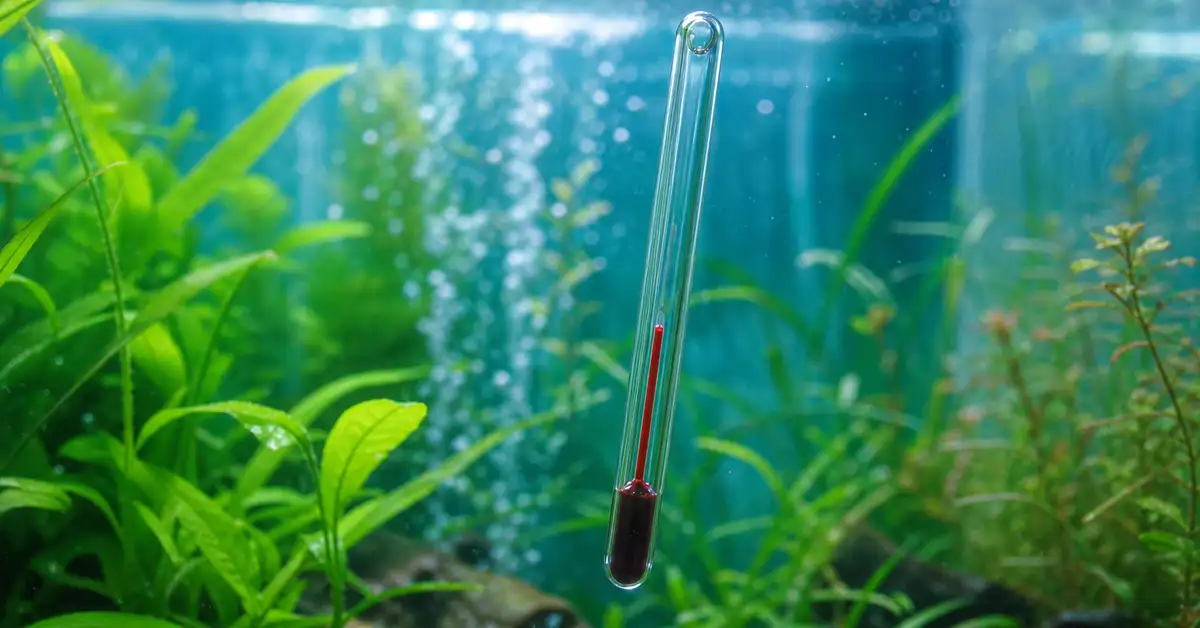
A classic liquid-filled glass thermometer that floats or suction-cups inside the tank, with a colored liquid column (never mercury — that’s been phased out of current production; see the safety note below) against a printed scale, often with a marked “tropical” green zone. No batteries, no electronics, nothing to fail except the glass itself.
Best for: aquarists who want the simplest, most failure-resistant option as either a primary or a cross-check thermometer.
Key specs: floating or suction-mounted glass construction · colored liquid column, non-mercury · roughly ±1°C (~1.8°F) accuracy on typical models · no battery required.
Pros: nothing electronic to fail, inexpensive, genuinely simple.
Cons: floating versions can spin with water movement so the scale faces away from view; glass can crack or chip against decor or an errant net — inspect periodically and handle carefully during maintenance.
Price band: $ · Evidence: retailer listings (Aquarium Co-Op, Chewy) confirm typical accuracy and non-mercury construction; a generic product with no single brand, so our October 2026 CPSC search (run by brand) does not cover it.
8. REPTI ZOO Dual-Probe Digital — Best for Comparing Two Points at Once
Originally marketed for reptile terrariums, this digital thermo-hygrometer with two separate probes has genuine aquarium-hobby use: aquarists use the dual-probe versions to compare a display tank against a sump, or one end of a long tank against the other, on a single unit. Honest disclosure: this is a cross-hobby product, not aquarium-specific, so its humidity-reading feature is irrelevant for a submerged application — you’re buying it purely for the dual-probe temperature comparison.
Best for: aquarists running a sump or a particularly long tank who want to compare two temperature points on one display.
Key specs: two independent probes · roughly ±2°F accuracy · suction-cup mountable display · up to a year of battery life.
Pros: genuinely useful for two-point comparison, inexpensive relative to buying two separate single-probe units, long battery life.
Cons: wider accuracy tolerance than dedicated aquarium digital thermometers; the humidity function is irrelevant for tank use.
Price band: $ · Evidence: manufacturer listing confirms dual-probe design and accuracy tolerance; no recall found for this thermometer in our October 2026 CPSC search.
9. Inkbird IBS-TH1 Plus — Best Wireless Smart Thermometer with Alerts
A wireless sensor that pairs with a free phone app over Bluetooth, showing live temperature (and humidity, which is not relevant for submerged use) with a companion aquarium-specific submersible probe, data logging up to 30,000 points, and configurable high/low alerts sent straight to your phone. This is the same brand behind the external heater controller we recommended in our heaters guide, and the two pair naturally: the ITC-308 controls the heater’s power, while this unit gives you a phone alert if temperature drifts outside your set range regardless of what’s causing it.
Best for: aquarists who want to be notified of a temperature problem remotely, rather than relying on someone physically checking the tank.
Key specs: wireless app-based monitoring (roughly 50m range) · internal sensor ±0.5°F, external submersible probe ±1°C · configurable high/low alerts · data logging up to 30,000 points · powered by 2 AAA batteries.
Pros: genuine remote phone alerts, data history for spotting slow drift over time, tighter published accuracy than most standalone digital thermometers.
Cons: depends on Bluetooth range and app reliability; not a substitute for glancing at the tank directly.
Price band: $$ · Evidence: manufacturer spec sheet and manual confirm accuracy, range and alert features; no recall found for this thermometer in our October 2026 CPSC search.
10. Infrared Laser Thermometer — Best Secondary Spot-Check, Not a Primary Reading
A handheld, non-contact infrared “temperature gun” that reads surface temperature from a distance. We’re including it specifically to be honest about its limits: aquarium glass and water have low emissivity, which is exactly the property infrared thermometers are least accurate on, and hobbyist discussion on Reef2Reef confirms readings can run several degrees off compared to a submerged thermometer, especially if aquarium lighting reflections interfere. It’s a genuinely handy tool for a fast top-up-water check or a rough second opinion — not for calibrating a heater or making a critical decision.
Best for: a quick, no-contact spot-check (like confirming water-change water isn’t ice cold) rather than as your primary tank thermometer.
Key specs: non-contact laser-targeted infrared sensor · roughly ±2% or ±3.6°F accuracy · wide measurement range, most of it irrelevant for aquarium use.
Pros: instant, no contact with water, useful for other household tasks too.
Cons: genuinely less accurate on aquarium glass/water than a contact thermometer; don’t use it as your only or most trusted reading.
Price band: $ · Evidence: manufacturer spec and hobbyist discussion (Reef2Reef) on real-world accuracy limitations disclosed above; a generic product with no single brand, so our October 2026 CPSC search (run by brand) does not cover it.
Placement best practices
A probe or glass thermometer should sit fully submerged, away from the direct heater output and away from intake/outflow dead zones, ideally mid-water rather than jammed against the glass in a corner with poor circulation. External stick-on strips read the temperature of the glass itself, which is influenced by room air on the other side — that’s a real limitation, not a defect, and it’s why we recommend a submerged probe or glass thermometer as your primary reading, with an external strip (if you use one) treated as a rough secondary glance.
A safety note: mercury and glass thermometers
Mercury aquarium thermometers have been effectively phased out of current production; the sale of mercury fever thermometers has been restricted in the US since the early 2000s, and current glass aquarium thermometers use colored alcohol or galinstan (a non-toxic mercury alternative) rather than mercury. Our October 2026 CPSC search found no recall for any branded thermometer recommended here. If you have an older glass thermometer of unknown origin and it breaks, treat any silvery, bead-like liquid with caution and avoid handling it directly — but a modern colored-liquid thermometer breaking is a cleanup and livestock-stress concern (glass shards), not a mercury hazard.
Frequently Asked Questions
General information only — not a substitute for following manufacturer instructions for any electronic device used near water.
Sources: Fluval: Digital Aquarium Thermometer FAQ · LiveAquaria: Coralife Digital Thermometer · Reef2Reef: What Is the Most Reliable Thermometer? · Bulk Reef Supply: Calibrating the JBJ True Temp Controller · JBJ True Temp Digital Heater Controller (retailer listing) · JBJ Digi-Temp Submersible Thermometer (retailer listing) · Aquarium Co-Op: Floating Glass Thermometer · REPTI ZOO Digital Thermometer Hygrometer (retailer listing) · Inkbird: IBS-TH1 Plus Manual · Reef Builders: Inkbird Wireless Smart Thermometer · Reef2Reef: Is an IR Thermometer Necessary? · Reef2Reef: Laser Guns for Water Temps