“Low light” isn’t a vibe — it’s a number. We spec-verified nine real plants against grower and aquarist documentation, drew a hard line between plants that merely tolerate low light and ones that genuinely thrive in it, and flagged where a “low-light” pick is commonly mis-sold as aquatic when it isn’t.
Low light, defined in numbers
Lumens-per-gallon is a leftover from incandescent-bulb days and doesn’t hold up with modern LEDs — it measures human-perceived brightness, not the photosynthetically useful light a plant actually receives. Grower and aquarist sources have largely moved to PAR (photosynthetically active radiation, measured in µmol/m²/s at the leaf). In practical terms: true shade-adapted epiphytes hold up from as low as 10 PAR; a few root-feeders we cover below want 20–35 PAR to look their best.
Tolerates vs. thrives — the distinction most guides blur
A plant that “tolerates” low light will survive, but may grow slowly, stretch (etiolate) toward the light, or stay sparse. A plant that “thrives” in low light does all its important business — steady leaf production, healthy color, resistance to algae — at those same PAR numbers. We call this distinction explicitly for every pick below, because it’s the difference between “this will limp along” and “this is actually the right plant for your light.”
A quick honesty check before you buy
Some plants sold in the aquarium trade for low-light tanks aren’t aquatic at all. Dracaena sanderiana (“lucky bamboo”) and Ophiopogon japonicus (“mondo grass”) are both terrestrial/bog plants that are commonly potted and sold in aquarium sections — they will rot if kept fully submerged long-term, and their frequent mislabeling has cost plenty of beginners a “dead plant, must be my fault” moment that was never their fault. Pothos (Epipremnum aureum) is often recommended for nutrient control with its roots dangling in tank water, which does work, but the plant itself is not aquatic and must stay emersed, leaves in air. None of the nine picks below have this problem — every one is confirmed as a genuine aquatic species or product.
This is the low-light spoke of our Best Aquarium Plants for Beginners hub — that guide covers the same species more broadly; this one exists to answer one specific question: “what actually grows under the light I already own?” Feeding root-feeders once they’re in? See our substrate guide for now, or our new best aquarium plant fertilizers guide. New tank? Cycle it first — see how to cycle a fish tank. Curious about the water chemistry these plants interact with? See aquarium water parameters.
Quick comparison
| Plant | PAR band | Tolerates or thrives at low light? | Root feeder? | Price band |
|---|---|---|---|---|
| 1. Java Fern | ~10–30 PAR | Thrives | No (epiphyte) | $ |
| 2. Anubias Nana | Low light demand (Tropica) | Thrives | No (epiphyte) | $$ |
| 3. Java Moss | — | Thrives | No (epiphyte) | $ |
| 4. Cryptocoryne wendtii | ~15–25 PAR | Tolerates low / thrives low-mod | Yes | $$ |
| 5. Hornwort | Low–high (floated) | Thrives if floated | No | $ |
| 6. Water Sprite | Low–moderate | Thrives if floated | Optional | $ |
| 7. Amazon Sword | ~20–30 PAR | Tolerates low / thrives low-mod | Yes | $$ |
| 8. Vallisneria | ~15–25 PAR | Tolerates low / thrives low-mod | Yes | $ |
| 9. Dwarf Sagittaria | ~20–35 PAR | Tolerates low / thrives medium | Yes | $$ |
The 9 best low-light aquarium plants (2026)
We earn a commission if you buy through links on this page, at no extra cost to you. It never affects which products we pick or how we rank them. Read our full disclosure policy.
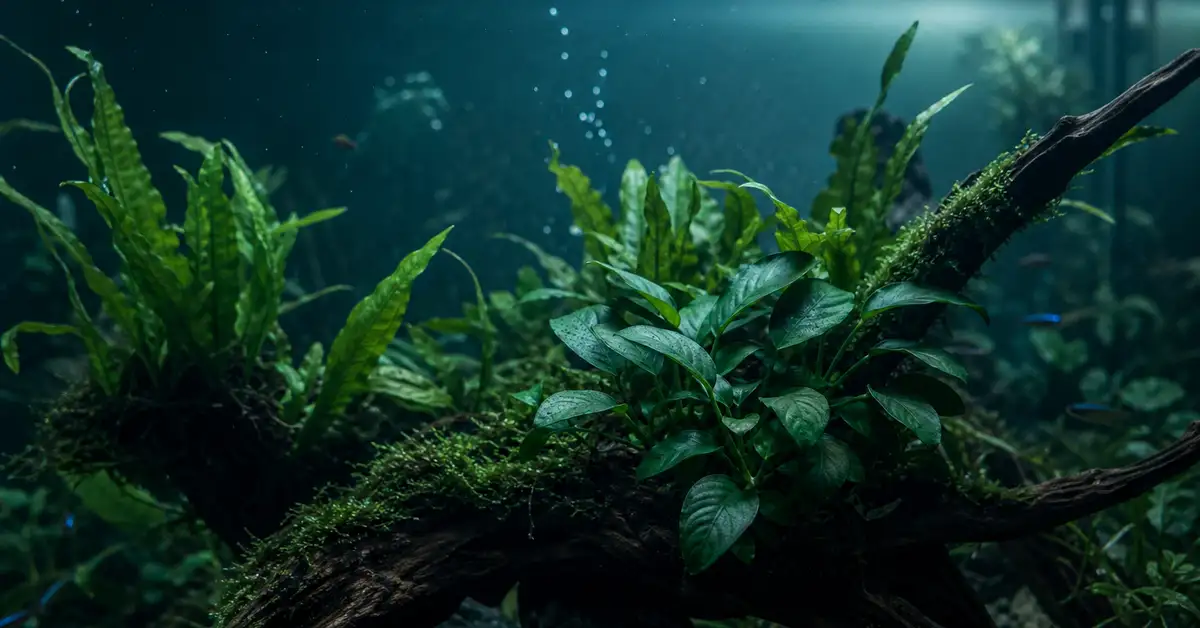
1. Java Fern (Microsorum pteropus) — Best True Low-Light Thriver
Java Fern genuinely thrives, not just survives, at PAR values as low as 10–30 µmol/m²/s. As an epiphyte it attaches to hardscape rather than rooting in substrate, so a thin-gravel or bare-bottom kit tank isn’t a limitation.
Best for: the single most reliable answer to “will anything actually grow under my stock hood light.”
Key specs: ~10–30 PAR, genuinely thrives (not just tolerates) at the low end · no CO2 required · epiphyte — attach to driftwood/rock, never bury the rhizome · slow-to-moderate growth.
Low-light failure mode: the risk at low PAR isn’t the plant dying, it’s algae — running a long photoperiod (10+ hours) to “make up for” a weak light feeds algae on Java Fern’s slow-turnover leaves far more than it helps the plant. Keep photoperiods to 6–8 hours regardless of light strength.
Pros: among the most forgiving plants in the hobby, no substrate planting required, keeps working even under a genuinely dim stock hood.
Cons: slow grower; buried rhizomes rot, a common beginner mistake carried over from substrate-plant habits.
Price band: $ · Evidence: grower/aquarist documentation (Aquazron, Aquarium Co-Op) puts genuinely-thriving PAR at roughly 10–30 µmol/m²/s.
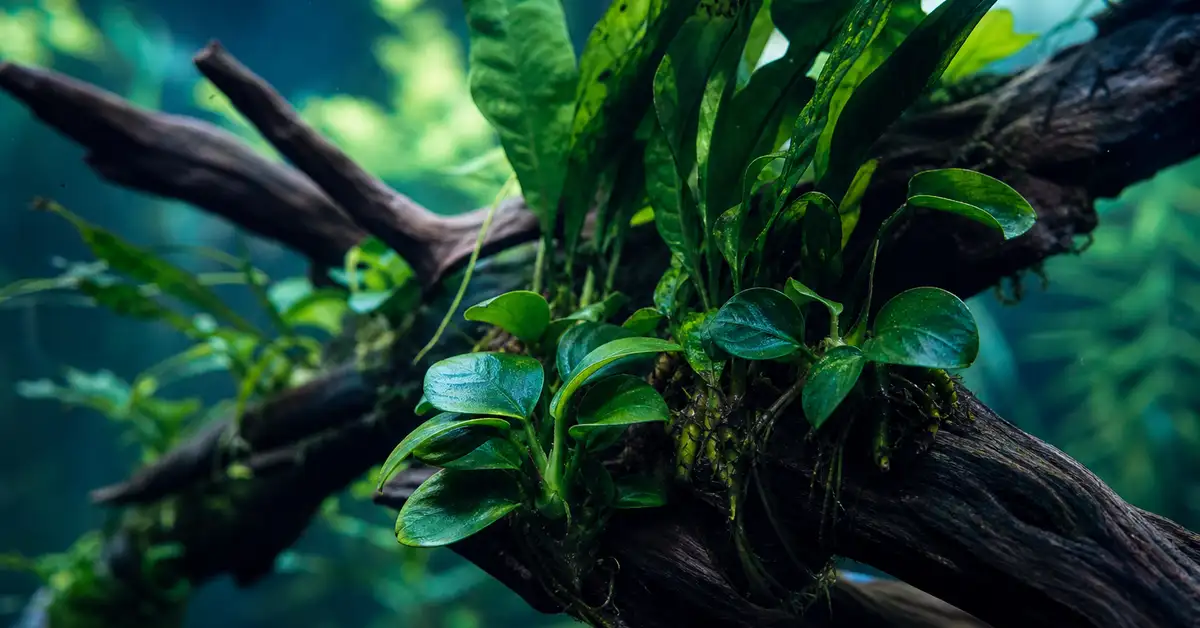
2. Anubias Nana (Anubias barteri var. nana) — Best for the Absolute Dimmest Tank
Tropica rates the light demand of Anubias nana as Low and says it will thrive in shady places, where other plants will not, which is why we pick it for the dimmest spot in a low-light tank. Growth is glacially slow, which in a beginner low-light tank is a feature, not a bug.
Best for: the darkest realistic beginner setup — a north-facing room, a deep tank, or a hood with an especially weak stock LED.
Key specs: Tropica rates its light demand as Low · no CO2 required · epiphyte, plant on stone or driftwood, never bury the rhizome · very slow growth (roughly one new leaf a month).
Low-light failure mode: because growth is so slow, older leaves sit in place long enough for algae (including black beard algae) to colonize them if nutrients are high and photoperiod is stretched to compensate for weak light. Moderate photoperiod, not more light exposure time, is the fix.
Pros: tolerant of the widest range of water chemistry on this list, dozens of leaf-shape/size cultivars available, essentially impossible to underlight.
Cons: slow enough that patience is a real requirement; rhizome burial causes rot exactly as with Java Fern.
Price band: $$ · Evidence: Tropica rates its light demand as Low and says it thrives in shady places.
3. Java Moss (Taxiphyllum barbieri) — Best Low-Light Texture & Fry Cover
Because Java Moss grows loosely attached to whatever it’s tied to, you can move it higher in the water column — closer to the light — if your tank runs dim.
Best for: softening hardscape, hiding equipment, and giving shrimp or fry somewhere to hide, all at low PAR.
Key specs: ties to hardscape or mesh, doesn’t root in substrate · spreads into a mat over weeks to months.
Low-light failure mode: dense mats trap detritus at the best of times; under low light with a long photoperiod added to compensate, filamentous algae and cyanobacteria can invade the mat faster than the moss can outcompete them. Trim and rinse periodically rather than letting mats thicken indefinitely.
Pros: genuinely undemanding, real functional shrimp/fry habitat, flexible attachment options.
Cons: traps detritus if never thinned; slower to fill in than fast stem plants.
Price band: $
4. Cryptocoryne wendtii — Best Low-Light Rosette With Real Color
Crypt wendtii is evolutionarily a forest-floor shade plant, comfortable at roughly 0.3–0.5 W/L (in older wattage terms) — genuinely low light. The honest caveat: it’s a root feeder, so a bare or thin-gravel kit tank without root tabs will underperform regardless of how much light you throw at it.
Best for: foreground-to-midground color and texture in a tank that already has at least 2–3 inches of substrate, or is willing to add root tabs.
Key specs: low-to-moderate light, roughly 15–25 PAR · no CO2 required (accelerates growth if added) · root feeder, needs 2–3″+ substrate depth or root tabs · tolerates low light but grows leggier/taller there vs. more compact under moderate light.
Low-light failure mode: under very low PAR, crypt wendtii puts energy into elongated, “leggy” petioles reaching for light rather than compact growth — not attractive, but not dying either. The more serious risk is “crypt melt”: sudden leaf die-back after a big change in light, water chemistry, or a move, which looks alarming but the plant usually regrows from the root system if the substrate stays healthy.
Pros: real color variation across cultivars (brown/green/red), tolerant of a wide hardness/TDS range, works in genuinely low light if substrate is right.
Cons: a heavy root feeder in a plant marketed as “low light” — the light isn’t the limiting factor as often as the substrate is; melt risk on any sudden change.
Price band: $$ · Evidence: detailed grower/care documentation (Aquaterra Obsession) specs light and substrate requirements and the melt phenomenon.
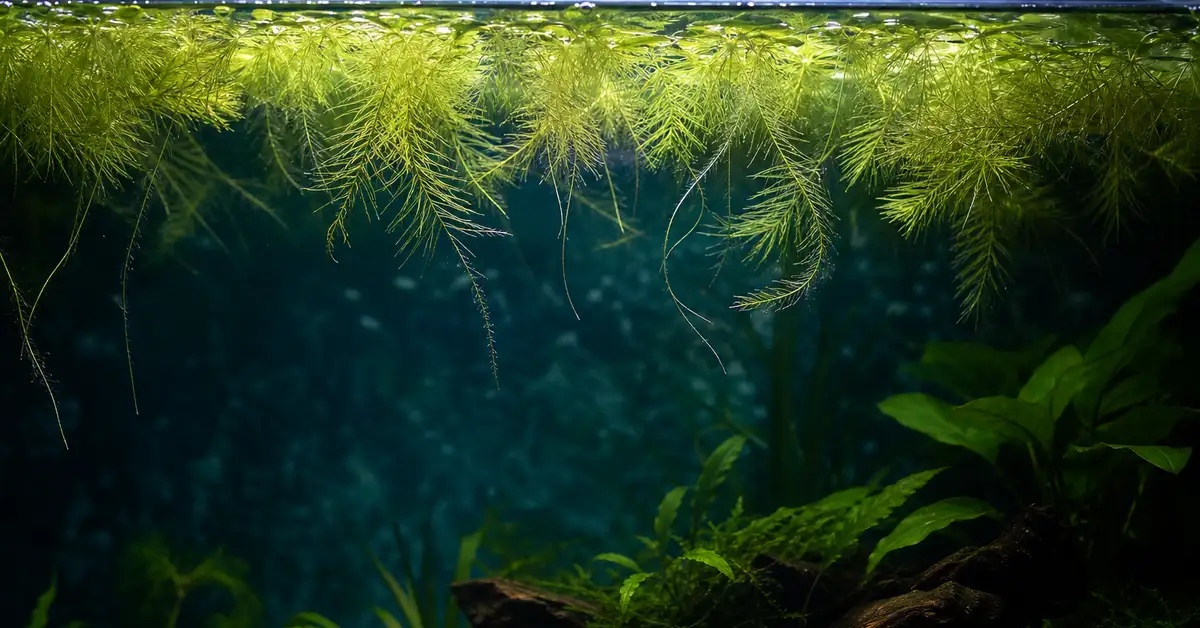
5. Hornwort (Ceratophyllum demersum) — Best Floated for Effective Low-Light Performance
Hornwort’s own PAR tolerance is broad (low to high), but the honest low-light trick is placement: floated at the surface, it sits closer to your stock hood LED than anything planted at substrate level ever could, so it experiences a meaningfully higher effective PAR than the same tank’s substrate zone — which is why it thrives under lights that would leave a planted stem struggling below.
Best for: a fast nutrient sponge and cover plant in a tank whose stock light is genuinely weak at the substrate but fine near the surface.
Key specs: low to high PAR tolerant, best floated for low-light tanks · no CO2 required · no true roots — floats, or loosely anchored (anchored ends tend to rot) · very fast growth when floated with adequate nutrients.
Low-light failure mode: if planted (rather than floated) in a genuinely low-light tank, the base of the stem sits in the dimmest zone and sheds needles — beginners often read this as the plant dying when it’s usually adapting. Floating avoids the problem entirely.
Honest disclosure: Hornwort is classified as invasive in some regions outside the US aquarium trade (notably Tasmania). Check your state’s regulated-species list before buying, and never release trimmings into any waterway.
Pros: genuinely thrives at low substrate-level PAR when floated, fast nutrient uptake helps a new tank’s water quality, inexpensive.
Cons: sheds needles on introduction or when planted in shade; fast growth needs regular thinning; regional invasive status is worth a two-minute check.
Price band: $ · Evidence: Aquarium Co-Op and Modern Aquarium grower/care documentation on light range and floating behavior; the Tasmanian Department of Natural Resources and Environment’s declared-weed page for the Tasmanian status, consistent with our existing Hornwort coverage on this site.
6. Water Sprite (Ceratopteris thalictroides) — Best Flexible Floating-or-Rooted Pick
Like Hornwort, Water Sprite’s real low-light trick is floating: fine, fern-like fronds sit near the surface where a stock hood delivers its highest PAR, and the plant can also be rooted if you’d rather it stay put — either way it holds up under lighting most stem plants would sulk in.
Best for: flexible low-light use as either a rooted midground plant or a floating cover/nutrient-absorber, where local regulations allow it.
Key specs: low-to-moderate PAR tolerant, higher effective PAR when floated · no CO2 required · grows rooted or free-floating · fast growth, propagates via plantlets on leaf margins.
Low-light failure mode: rooted in a genuinely dim tank, Water Sprite produces thin, sparse fronds that can break down into detritus rather than forming the dense growth it’s known for — floating solves this by putting the plant where the light actually is.
Honest disclosure: Water Sprite carries a regional invasive-species caveat — documented as invasive in Louisiana (rated Tier II) and common in central/southern Florida waterways; California’s agriculture department historically rated it a noxious weed pest (a “B” rating) but has since downgraded it to a low-concern “D” rating after the one known California population failed to persist. Check your state’s list before buying, and never release trimmings into any natural waterway.
Pros: genuinely flexible, thrives near the surface under lights that struggle at substrate level, fast growth helps new-tank water quality.
Cons: regional invasive-species status means a quick regulation check before buying; fast growth needs thinning, since floating mats can shade out plants below.
Price band: $ · Evidence: University of Florida IFAS plant directory profile confirms US naturalization history and Western Australia invasive status; California Department of Food & Agriculture pest rating profile confirms the regional US status described above, consistent with our existing Water Sprite coverage on this site.
7. Amazon Sword (Echinodorus bleheri) — Best Low-Light Centerpiece, With a Substrate Caveat
Amazon Sword genuinely does well in poorly-illuminated aquariums and grows toward the light rather than dying under it — but the honest framing here is “tolerates low light” rather than “thrives” the way Java Fern does; full, dense growth wants somewhat more light plus a nutrient-rich substrate.
Best for: a background/centerpiece plant in a tank with at least a basic nutrient-bearing substrate or a root-tab routine, where a stock hood is on the dimmer side.
Key specs: tolerates low light, thrives closer to ~20–30 PAR · low CO2 demand, not required · root feeder, plants in substrate, benefits from root tabs · can grow large, needs room.
Low-light failure mode: in a genuinely dim, low-nutrient tank, Amazon Sword survives but shows yellowing older leaves, smaller new growth and longer petioles reaching for the surface — a substrate/nutrient problem that looks like a light problem. Root tabs fix this faster than adding more light does.
Pros: real visible growth for a beginner who wants progress, works as a genuine focal point.
Cons: needs more nutrients than the epiphytes above to actually thrive at low PAR, not just survive; can outgrow a small tank.
Price band: $$ · Evidence: Tropica grower documentation confirms low light-demand classification and substrate/nutrient dependency.
8. Vallisneria (Vallisneria spp.) — Best Low-Light Background Grass, Fed Not Just Lit
Vallisneria’s own care documentation actually recommends a dedicated plant LED for best results — the honest reframe for a low-light beginner tank is that Vallisneria will tolerate a stock hood and spread via runners regardless, but the real lever isn’t more light, it’s feeding (fish waste or liquid fertilizer); undernourished Vallisneria under-performs even with decent light.
Best for: a background “grass wall” that fills in on its own over months, in a tank with reasonable bioload or a fertilizing routine.
Key specs: tolerates ~15–25 PAR, thrives with adequate feeding more than with more light · no CO2 required · roots in substrate, spreads via runners · tall ribbon-like leaves.
Low-light failure mode: under weak light and low nutrients together, Vallisneria etiolates (thin, elongated leaves reaching the surface) and sends fewer runners, slowing the “grass wall” effect beginners want. Feeding the plant, not just upgrading the light, is usually the actual fix.
Pros: low-maintenance once established, spreads on its own, tolerant of a wide range of water conditions.
Cons: can need trimming at the surface in shallow tanks; performance is nutrient-gated as much as light-gated.
Price band: $ · Evidence: Aquarium Co-Op care guide specifies feeding requirements and recommended light tier.
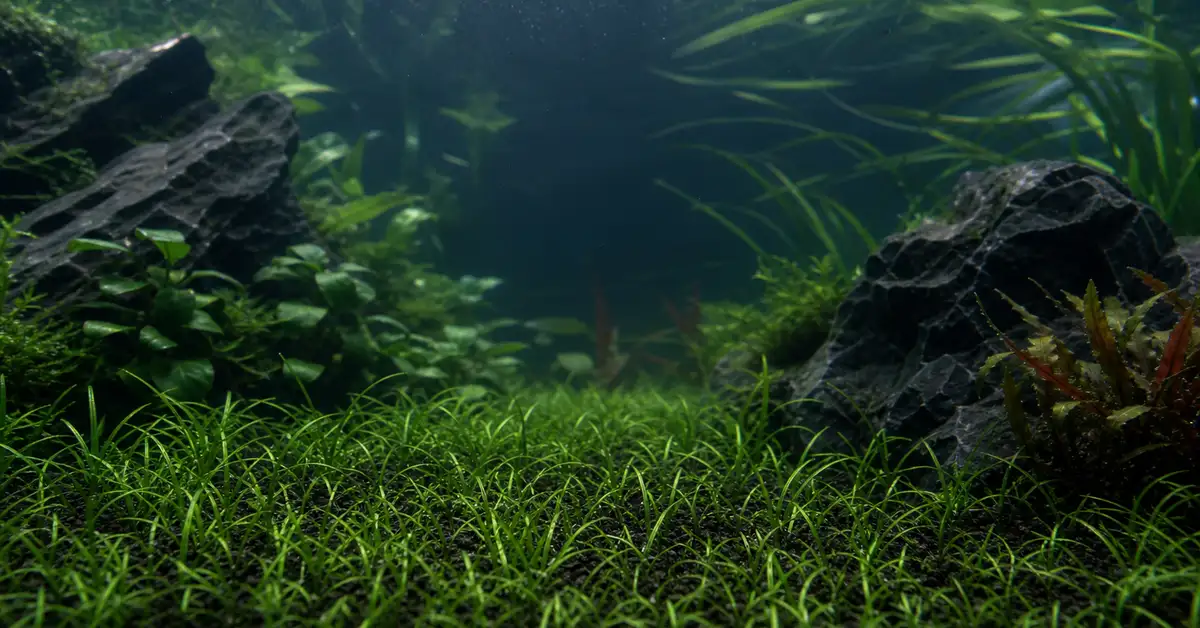
9. Dwarf Sagittaria (Sagittaria subulata) — Best Carpet Attempt Without Upgrading Lights
Dwarf Sagittaria is specced at 20–35 PAR for its best, shortest, carpet-forming growth — genuinely at the top edge of what a stock hood delivers, so the honest expectation-setting matters here: under a true low-light stock hood, expect taller, sparser blades rather than a dense lawn, not a dead plant.
Best for: beginners who want to attempt a foreground carpet without moving to a high-tech CO2 setup, with realistic expectations about density.
Key specs: ~20–35 PAR for dense carpet growth, tolerates lower PAR with taller/sparser growth · no CO2 required, denser with more light · root feeder, spreads via runners, benefits from root tabs · low grass-like habit.
Low-light failure mode: at the low end of a stock hood’s output, Dwarf Sagittaria tends to grow tall and vertical rather than spreading into a lawn — not a failure exactly, but not the carpet look most people buy it for. Root tabs help density more than extending the photoperiod does.
Pros: a genuinely achievable carpet-style plant without CO2 injection, spreads on its own once established, tolerant of hard water.
Cons: the true carpet look wants light toward the higher end of what a stock hood provides; slower and sparser at the low end.
Price band: $$ · Evidence: Aquarium Co-Op product documentation specifies the 20–35 PAR recommendation and the taller-in-lower-light growth pattern.
Low-light failure modes, in one place
Three patterns cause most low-light planted-tank disappointment, and none of them are really about the light itself: melt on introduction (most visible on Cryptocoryne wendtii after transport or a big water-chemistry change — give it weeks, not days, before judging); algae from over-long photoperiods (running lights 10+ hours to “compensate” for a weak fixture feeds algae faster than it feeds slow-growing epiphytes like Java Fern and Anubias — keep photoperiods to 6–8 hours regardless of light strength); and root-feeder nutrient starvation (Cryptocoryne, Amazon Sword, Vallisneria and Dwarf Sagittaria are all root feeders that will underperform in plain gravel with no root tabs, no matter how much light you add — see our substrate guide for nutrient-capable options, or our plant fertilizer guide).
What our beginner hub doesn’t tell you
Our broader Best Aquarium Plants for Beginners guide covers these same nine species among eleven overall, but in general “low to moderate” terms. This guide exists because “low to moderate” isn’t precise enough to plan around: here, every pick carries an explicit tolerates-vs-thrives verdict and the specific failure mode that shows up at low light specifically — the detail a forum thread rarely bothers to work out and a retailer listing has no incentive to disclose.
What we can’t verify
We haven’t grown any of these nine plants ourselves — the PAR figures above come from grower and aquarist documentation (Tropica, Aquarium Co-Op, Aquazron, Aquaterra Obsession), cross-checked where more than one source was available, and should be read as reliable bands rather than laboratory-precise numbers for your specific fixture and tank depth. Invasive-species regulation can change and varies by state; always check your own state’s current regulated-species list before buying if you have any doubt about Hornwort or Water Sprite specifically.
Frequently Asked Questions
General information only. Always confirm your own state’s current invasive/regulated aquatic plant list before purchasing Hornwort or Water Sprite specifically, and never release aquarium plants or trimmings into natural waterways.
Sources: Aquarium Co-Op: Java Fern Care Guide · Aquarium Co-Op: Windelov Java Fern PAR Spec · Aquazron: Java Fern Low-Tech Suitability · Tropica: Anubias barteri var. nana · Aquarium Co-Op: Java Moss PAR Spec · Aquaterra Obsession: Cryptocoryne wendtii Care · Aquarium Co-Op: Hornwort Care · Modern Aquarium: Hornwort · NRE Tasmania: Hornwort (declared weed) · UF/IFAS: Ceratopteris thalictroides · California CDFA: Ceratopteris thalictroides (Water Sprite) Pest Rating Profile · Tropica: Echinodorus grisebachii ‘Bleherae’ (Amazon Sword) · Aquarium Co-Op: Vallisneria Care · Aquarium Co-Op: Dwarf Sagittaria PAR Spec
As an Amazon Associate I earn from qualifying purchases.