The easiest beginner aquarium plants share three traits: they tolerate low light, need no CO2 injection, and forgive an inconsistent fertilizing schedule. We researched 11 real, currently-sold plants (and one popular “plant” that’s actually an algae) that meet that bar, spec-verified their light and care needs against manufacturer and grower documentation, and screened every pick for invasive-species regulation status — a real consideration for live plants that most beginner guides skip entirely.
How we chose these plants
We pulled light requirements, growth habit, substrate needs and CO2 dependency directly from established aquatic-plant growers and retailers (Aquarium Co-Op, Canton Aquatics, Aquarium Plants Factory) and cross-checked against independent aquascaping education sources. Live plants don’t carry US CPSC recalls the way electrical gear does, but they carry a comparable safety-adjacent risk: invasive-species regulation. We checked every species against USDA federal noxious weed status and state-level invasive plant lists. One species we deliberately did not include is Hygrophila polysperma (“Indian swampweed”), a federally listed noxious weed regulated in at least 14 US states where it’s illegal to import, sell or purchase — it’s sometimes still mislabeled or sold under confusing names, so if you see it offered, skip it. We also flag three picks below with real, honestly-disclosed caveats: Water Sprite’s and Hornwort’s regional invasive status, and a documented 2021 contamination event affecting mass-market Marimo moss balls. Full method: How We Choose.
Last updated July 2026. This is the hub for our Planted & Aquascaping cluster. Keeping a betta specifically? See our best plants for betta tanks guide for fin-safe picks. Choosing substrate for a planted tank? See our substrate guide. Want the water-chemistry reference these plants interact with? See our water parameters guide. New tank? Cycle it first — see how to cycle a fish tank. Want the exact PAR numbers behind “low light” instead of general bands? See our best low-light aquarium plants deep dive, which covers these same species with tolerates-vs-thrives verdicts and specific PAR ranges. Ready to actually build the layout? See our how to aquascape a planted tank guide for the hardscape-to-planting build order.
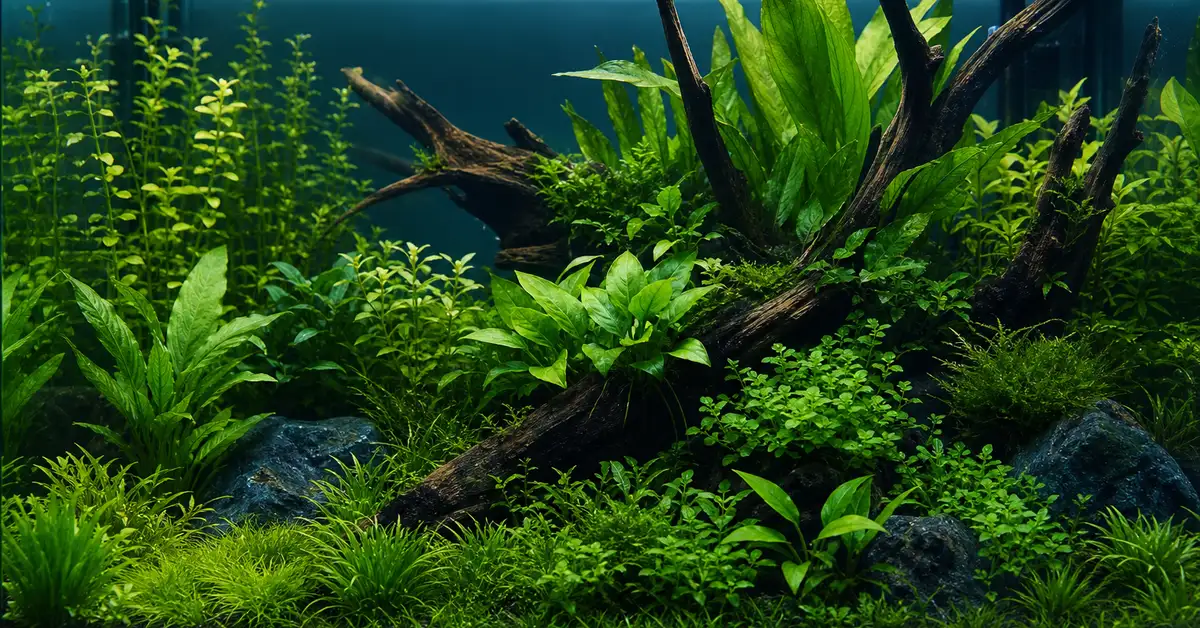
Why “low light, no CO2” matters for a first planted tank
Every plant on this list can survive and generally thrive under a standard aquarium kit light with no supplemental CO2 injection — a genuinely important beginner filter, since demanding carpet plants and high-light stems (the kind that need pressurized CO2 and daily dosing) are a common reason first-time planted tanks fail. A photoperiod of roughly 6-8 hours a day suits all of these species; pushing past about 10 hours tends to feed algae more than the plants themselves. If you eventually outgrow this and want to move into a high-tech, CO2-injected setup, see our CO2 systems guide for how to do that safely.
Quick comparison
| Plant | Light | Placement | CO2 needed? | Price band |
|---|---|---|---|---|
| 1. Java Fern | Low-high | Attach to hardscape | No | $ |
| 2. Anubias Nana | Low-moderate | Attach to hardscape | No | $ |
| 3. Amazon Sword | Moderate | Substrate, background | No | $ |
| 4. Cryptocoryne wendtii | Low-moderate | Substrate, foreground/mid | No | $ |
| 5. Vallisneria | Low-moderate | Substrate, background | No | $ |
| 6. Java Moss | Low-moderate | Attach to hardscape | No | $ |
| 7. Water Wisteria | Low-moderate | Substrate or floating | No | $ |
| 8. Dwarf Sagittaria | Moderate | Substrate, foreground carpet | No | $ |
| 9. Water Sprite | Low-moderate | Substrate or floating | No | $ |
| 10. Hornwort | Low-moderate | Floating or loosely planted | No | $ |
| 11. Marimo Moss Ball | Low-moderate | Free-standing, no substrate | No | $ |
The 11 best beginner aquarium plants (2026)
Transparency first: This guide contains affiliate links. If we’re enrolled in an affiliate program, we may earn a commission at no extra cost to you — it never affects how we research or rank. Read our full affiliate disclosure policy.
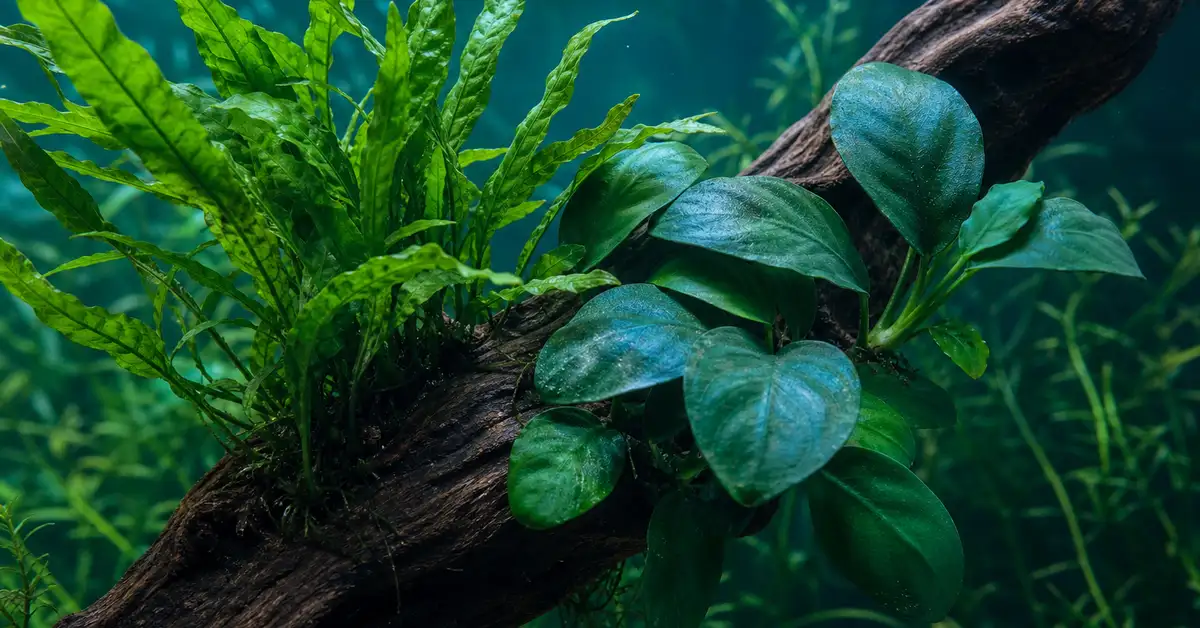
1. Java Fern (Microsorum pteropus) — Best Overall, Hardest to Kill
Java Fern is the plant most independent aquarist sources point beginners toward first: it tolerates everything from very low to fairly bright light, needs no CO2, and attaches to driftwood or rock via its rhizome rather than rooting in substrate — which also means it can’t be planted incorrectly the way substrate plants sometimes are.
Best for: a true first plant for any beginner tank, especially if you’re not confident in your substrate or lighting setup yet.
Key specs: low to high light tolerant · no CO2 required · attaches to hardscape via rhizome, do not bury the rhizome in substrate · slow-to-moderate growth.
Pros: genuinely close to unkillable under normal conditions, no substrate planting required, widely available.
Cons: slow grower, so it won’t quickly fill out a bare tank; melts back if the rhizome is buried, a common beginner mistake.
Price band: $ · Evidence: grower/retailer documentation confirms light tolerance and rhizome-based attachment; no invasive-species regulation found for this species.
2. Anubias Nana — Best No-Substrate Epiphyte
Like Java Fern, Anubias attaches to hardscape rather than rooting in substrate, tolerates low to moderate light without CO2, and is genuinely difficult to overwater or underfeed into decline — among the most forgiving plants sold for freshwater tanks.
Best for: beginners who want a genuinely low-maintenance centerpiece or accent plant attached to driftwood or rock.
Key specs: low to moderate light · no CO2 required · attaches to hardscape via rhizome · very slow growth (roughly one new leaf a month).
Pros: extremely tolerant of imperfect conditions, wide range of leaf sizes and varieties available, low nutrient demand.
Cons: very slow growth means patience is required; like Java Fern, the rhizome must stay above the substrate.
Price band: $ · Evidence: grower documentation confirms light tolerance and growth rate; no invasive-species regulation found for this species.
3. Amazon Sword (Echinodorus) — Best Substrate Centerpiece
Amazon Sword is a genuine root-feeder rather than an epiphyte, planted directly in substrate, and grows noticeably faster than Java Fern or Anubias — adding new leaves every one to two weeks under decent conditions — making it a satisfying centerpiece for a beginner who wants visible progress.
Best for: a background or centerpiece plant in a tank with at least a basic nutrient-bearing substrate or root tabs.
Key specs: moderate light · no CO2 required, but benefits from root tabs every 2-3 months · plants directly in substrate · can grow quite large, needs room.
Pros: genuinely fast, visible growth compared with epiphyte plants, works well as a real focal point, widely available.
Cons: needs more light and nutrients than Java Fern or Anubias to thrive; can outgrow a small tank over time.
Price band: $ · Evidence: grower documentation confirms growth rate and root-tab benefit; no invasive-species regulation found for this species.
4. Cryptocoryne wendtii — Best Low-Light Root Feeder
Cryptocoryne wendtii roots in substrate like Amazon Sword but stays considerably more compact, tolerates lower light, and is known for one quirk worth knowing in advance: “crypt melt,” where leaves die back after a big change in water conditions before regrowing from the root system — alarming to a beginner who doesn’t expect it, but not usually fatal to the plant.
Best for: a compact foreground-to-midground root-feeding plant in lower-light setups than Amazon Sword tolerates.
Key specs: low to moderate light · no CO2 required · plants in substrate, benefits from root tabs · compact growth habit versus Amazon Sword.
Pros: genuinely tolerant of lower light than most root-feeders, compact size suits smaller tanks, wide range of leaf colors and textures across varieties.
Cons: “crypt melt” after transplanting or a big water change can look alarming even though the plant usually recovers — don’t panic and uproot it.
Price band: $ · Evidence: grower documentation confirms light tolerance and the melt phenomenon; no invasive-species regulation found for this species.
5. Vallisneria — Best Tall Background Grass
Vallisneria’s long, ribbon-like leaves create a natural background curtain effect, spreading via runners to fill in a back row over time. It’s genuinely undemanding on light and nutrients, making it a popular low-effort background choice.
Best for: a background “grass wall” look with minimal ongoing care once established.
Key specs: low to moderate light · no CO2 required · plants in substrate, spreads via runners · tall, ribbon-like leaves.
Pros: genuinely low-maintenance once established, spreads on its own to fill in a background row, tolerates a wide range of water conditions.
Cons: can grow tall enough to need trimming at the water surface in shallower tanks; spreads via runners, which some aquascapers find gets messy without occasional thinning.
Price band: $ · Evidence: grower documentation confirms light tolerance and runner-based spreading; no invasive-species regulation found for this species in typical aquarium retail contexts.
6. Java Moss — Best Moss for Hardscape & Fry Cover
Java Moss attaches to driftwood, rock or mesh and spreads into a dense mat, commonly used to soften hardscape, provide cover for shrimp and fry, or carpet a piece of wood. It’s undemanding on light and grows in essentially any freshwater setup.
Best for: softening hardscape edges, providing shrimp/fry cover, or a low-effort mossy aesthetic.
Key specs: low to moderate light · no CO2 required · attaches to hardscape or mesh, does not root in substrate · spreads into a dense mat over time.
Pros: genuinely undemanding, provides real functional cover for shrimp and fry, versatile attachment options.
Cons: can trap detritus within the mat if not occasionally rinsed or thinned; slower to fill in than some stem plants.
Price band: $ · Evidence: grower documentation confirms attachment method and light tolerance; no invasive-species regulation found for this species.
7. Water Wisteria (Hygrophila difformis) — Best Fast-Growing Beginner Stem Plant
Water Wisteria is a fast-growing stem plant that can either be planted in substrate or left floating, and its rapid growth makes it a genuinely effective nutrient-absorber in a new or lightly-planted tank. Important distinction: this is a different species from Hygrophila polysperma, the federally-regulated noxious weed we deliberately excluded from this guide — confirm you’re buying H. difformis specifically, since names in the trade can be inconsistently labeled.
Best for: beginners who want fast, visible growth and a plant that helps outcompete early algae by soaking up excess nutrients.
Key specs: low to moderate light · no CO2 required · plants in substrate or floats freely · fast growth, benefits from regular trimming.
Pros: genuinely fast growth that helps establish a new tank’s nutrient balance, flexible planted-or-floating use, inexpensive.
Cons: regarded as invasive in parts of the southern US outside the aquarium trade, so never release trimmings into local waterways; fast growth means more frequent trimming than slower plants on this list.
Price band: $ · Evidence: IUCN and botanical sources confirm this is a distinct, non-federally-regulated species from H. polysperma; grower documentation confirms light tolerance and growth habit.
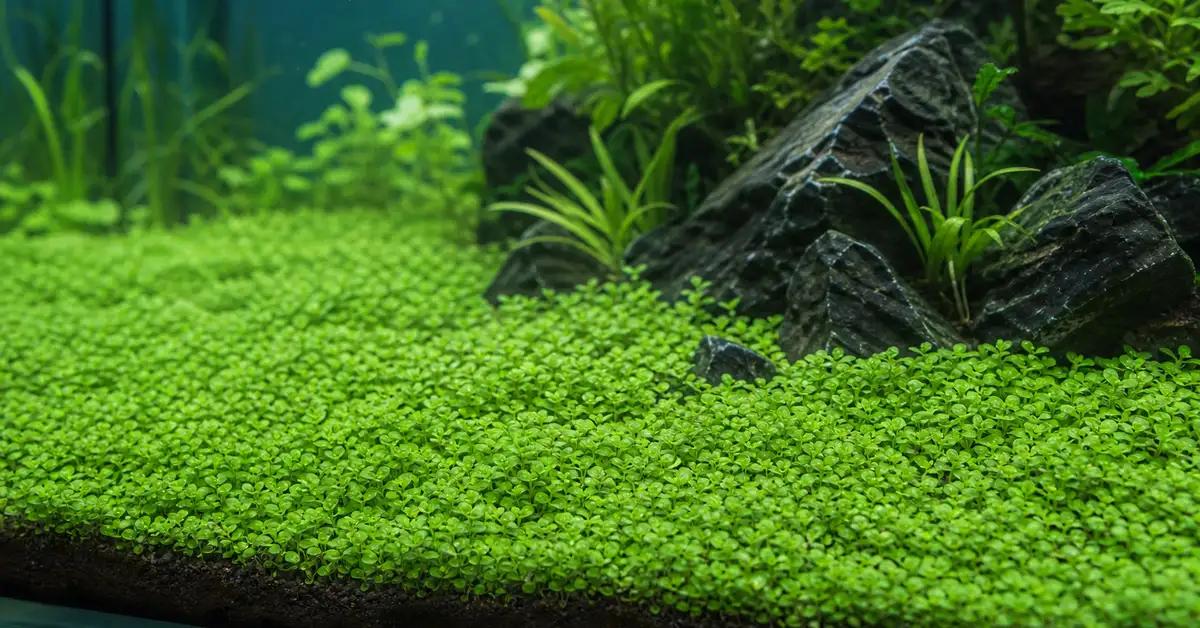
8. Dwarf Sagittaria — Best Foreground Carpet
Dwarf Sagittaria spreads via runners to form a genuine low-growing carpet across the substrate, one of the few true carpet-style plants that doesn’t demand high light or CO2 injection to establish — most dedicated carpet plants popular in high-tech aquascaping do require both.
Best for: beginners who want a carpeted foreground look without moving to a high-tech CO2 setup.
Key specs: moderate light · no CO2 required, though growth is denser with more light · plants in substrate, spreads via runners · low, grass-like growth habit.
Pros: genuinely achievable carpet effect without CO2, spreads on its own once established, tolerant of moderate rather than intense light.
Cons: establishes more slowly than high-tech carpet plants; benefits from root tabs for denser growth.
Price band: $ · Evidence: grower documentation confirms carpet growth habit and CO2-optional status; no invasive-species regulation found for this species.
9. Water Sprite (Ceratopteris thalictroides) — Best Floating-or-Rooted Flexible Pick
Water Sprite can be grown either rooted in substrate or left entirely free-floating, with feathery, fern-like leaves that provide genuine cover for shy fish, shrimp and fry. Its rapid growth and nutrient uptake make it a popular choice for helping a new tank’s water quality settle in. Honest disclosure: Water Sprite carries a regional invasive-species caveat, the same way Hornwort does below. It’s a documented invasive in Louisiana (rated Tier II) and is common in central and southern Florida waterways; California’s agriculture department historically rated it a noxious weed pest (a “B” rating) but has since downgraded it to a low-concern “D” rating after the one known California population failed to persist. It remains widely and legally sold across most of the US aquarium trade, but check your state’s regulated-species list before buying, and never release trimmings into any natural waterway.
Best for: flexible use as either a rooted background plant or a floating nutrient-absorber and cover plant — where local regulations allow it.
Key specs: low to moderate light · no CO2 required · grows rooted or free-floating · fast growth.
Pros: genuinely flexible planting style, fast growth helps establish new-tank water quality, provides real cover for shy or young fish.
Cons: regional invasive-species status means it’s worth a quick regulation check before buying, same as Hornwort; fast growth means regular thinning if floating, since it can shade out light to plants below.
Price band: $ · Evidence: California Department of Food & Agriculture pest rating profile and Louisiana noxious aquatic vegetation guidance confirm the regional invasive status described above; grower documentation confirms flexible growth habit and light tolerance.
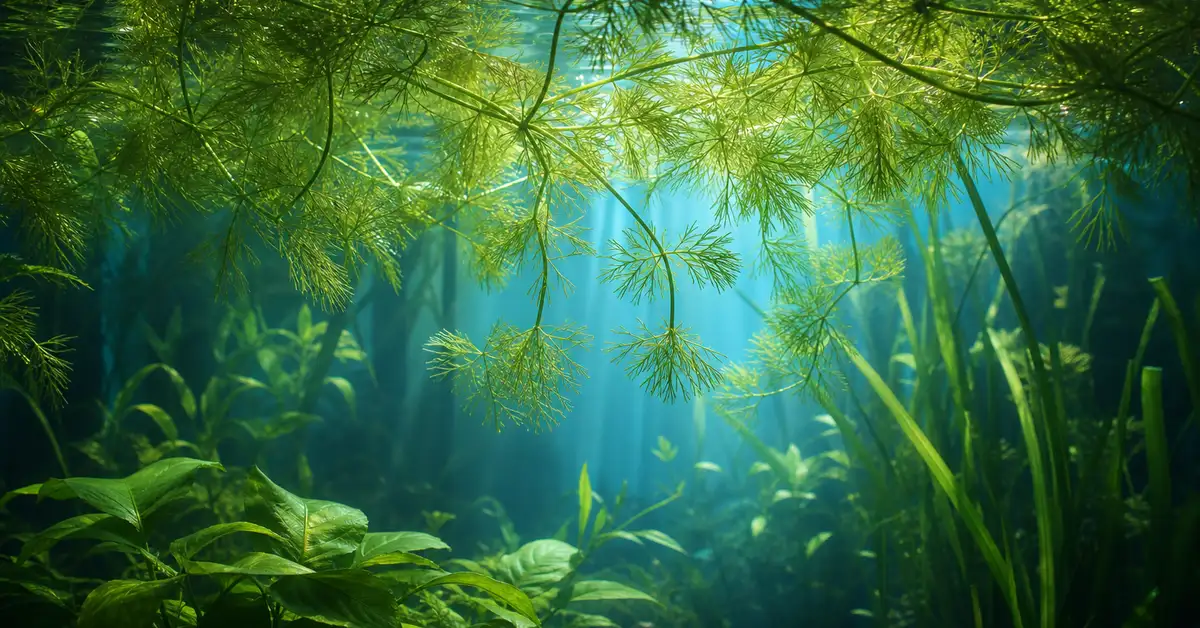
10. Hornwort (Ceratophyllum demersum) — Fast Growth, Regional Caveat
Hornwort is an extremely fast-growing, undemanding plant usually sold as loose floating or weighted stems, popular for rapidly absorbing excess nutrients in a new tank. Honest disclosure: Hornwort is classified as invasive in some regions outside the US aquarium trade (notably Tasmania and New Zealand), and while it’s widely and legally sold in most US states, check your specific state’s regulated-species list before buying, and never release trimmings into any natural waterway regardless of where you live.
Best for: rapid nutrient uptake and fast, low-effort greenery in a new or algae-prone tank — where local regulations allow it.
Key specs: low to moderate light · no CO2 required · sold as loose stems, floats or can be loosely planted · very fast growth.
Pros: genuinely fast growth and nutrient uptake, very undemanding on light, inexpensive.
Cons: regional invasive-species status means it’s worth a quick regulation check before buying; fast growth needs regular thinning; never dispose of trimmings in waterways.
Price band: $ · Evidence: IUCN Global Invasive Species Database confirms regional invasive classification; grower documentation confirms growth habit and light tolerance.
11. Marimo Moss Ball — Best No-Care Novelty (Really an Algae)
Marimo “moss balls” aren’t moss or a vascular plant at all — they’re a slow-growing form of Cladophora algae that naturally forms into soft spheres. They need no substrate, no real care beyond an occasional gentle roll and rinse, and genuinely help absorb some excess nitrate and phosphate. Honest disclosure, and an important one: in February-March 2021, invasive zebra mussels were discovered attached to and inside mass-market Marimo moss balls sold nationwide at major pet retailers, triggering a multi-state advisory and voluntary retailer withdrawal. If you buy a Marimo ball, inspect it closely before adding it to your tank, and if you have any doubt, the recommended safe-disposal method for a suspect ball is to destroy it and dispose of it sealed in household trash — never in a drain, waterway or garden. Buying from a specialty aquatic grower rather than a mass-market bin reduces this risk considerably.
Best for: a genuinely zero-maintenance green accent, especially popular in shrimp and betta tanks, for owners who inspect it carefully on arrival.
Key specs: low to moderate indirect light · no CO2, no substrate, no real pruning needed · slow-growing Cladophora algae, not a true plant.
Pros: genuinely the lowest-maintenance option on this list, absorbs some nitrate and phosphate, provides shrimp shelter.
Cons: the 2021 zebra mussel contamination event is a real, documented risk with mass-market sourcing — inspect on arrival and buy from a reputable specialty grower where possible.
Price band: $ · Evidence: US Fish & Wildlife Service and multiple state invasive-species agencies confirmed the 2021 contamination event and retailer response; grower documentation confirms general care requirements.
Getting new plants into your tank safely
Beyond the invasive-species and contamination notes above, it’s worth quarantining or at least rinsing and visually inspecting any new plant for hitchhiking snails, snail eggs or algae before adding it to an established tank — a common, low-effort way beginners accidentally introduce unwanted pests. Root-feeding plants (Amazon Sword, Cryptocoryne, Vallisneria, Dwarf Sagittaria) benefit from root tabs pushed into the substrate near their base every 2-3 months; epiphytes (Java Fern, Anubias, Java Moss) generally do better with a liquid fertilizer dosed into the water column instead, since they don’t have a substrate root system to feed. See our substrate guide for planted-tank-appropriate options.
What we can’t verify
We haven’t grown every one of these plants in our own tanks under controlled conditions — light and growth-rate figures come from grower and retailer documentation, cross-checked where more than one source was available. Invasive-species regulation can change and varies by state; always check your own state’s current regulated-species list before buying if you have any doubt about a specific species.
Frequently Asked Questions
General information only. Always confirm your own state’s current invasive/regulated aquatic plant list before purchasing, and never release aquarium plants or trimmings into natural waterways.
Sources: Aquarium Co-Op: Marimo Moss Ball Care Guide · Canton Aquatics: Best Beginner Aquarium Plants · UF/IFAS: Hygrophila polysperma · California CDFA: Ceratopteris thalictroides (Water Sprite) Pest Rating Profile · IUCN Global Invasive Species Database: Ceratophyllum demersum · US Fish & Wildlife Service: Invasive Zebra Mussels Found in Moss Balls (2021) · USDA APHIS: Federal Noxious Weeds Poster