Written by Michael Probert, a research-led fishkeeper — not a lab or an aquatic vet. See our How We Choose methodology. This guide is general information, not veterinary advice.
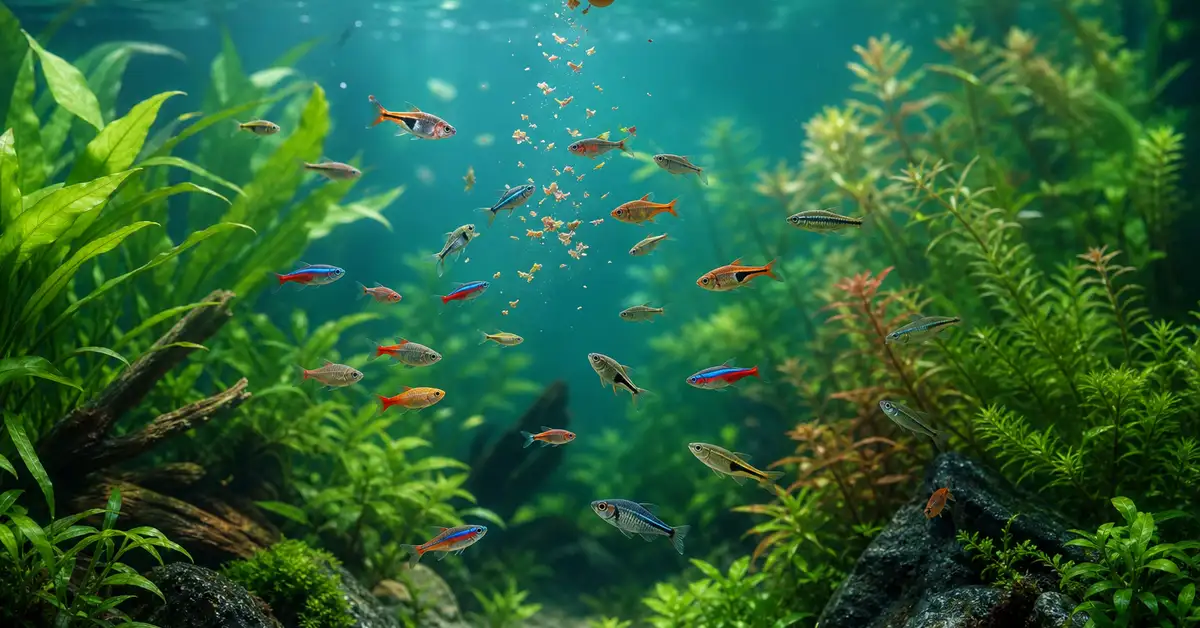
Most adult community fish do well on one or two feedings a day, with only as much food as they can finish in about two minutes. A typical adult betta needs roughly two to four small pellets per feeding, once or twice a day — closer to four to eight pellets total, not a pinch to “keep them full.” Bottom feeders like corydoras and plecos need their own separate, sinking food, usually offered once daily or every other day. Overfeeding — not underfeeding — is the single biggest mistake beginners make, because uneaten food doesn’t just vanish: it breaks down into ammonia and can turn a stable tank toxic within hours.
Why feeding is a water-quality decision, not just a fish-care one
An aquarium is a closed system. Every flake or pellet you add either becomes fish, or it becomes waste that your filter’s bacteria have to process — there’s no “away” for uneaten food to go. That’s the single idea behind almost every feeding recommendation in this guide, and it’s why “how much to feed” and “how to keep ammonia at zero” are really the same question. For the full picture of how that bacteria colony gets established in the first place, see our guide to cycling a fish tank, and for the safe ranges you’re testing against, see our aquarium water parameters reference.
How much and how often to feed community fish
For typical tropical community fish — tetras, rasboras, danios, barbs, livebearers, small cichlids — the RSPCA’s care guidance and retailers including PetSmart converge on feeding once or twice a day, with each portion sized so it’s fully gone within about two to three minutes. RSPCA Victoria adds a practical detail worth repeating: remove any food that’s still sitting in the tank after that window, rather than letting fish “graze” on it, since it will otherwise break down and add to the ammonia load. Larger community cichlids, such as angelfish, generally do well on one daily feeding of appropriately sized pellets plus an occasional frozen-food treat two or three times a week.
How many fish you’re feeding matters as much as the schedule. A tank stocked toward the upper end of what its filtration and water-change routine can handle needs more conservative feeding than a lightly stocked one — see our stocking guide for the fuller framework on bioload, since overstocking and overfeeding push a tank toward the same ammonia problem from two different directions.
How many pellets to feed a betta fish per day
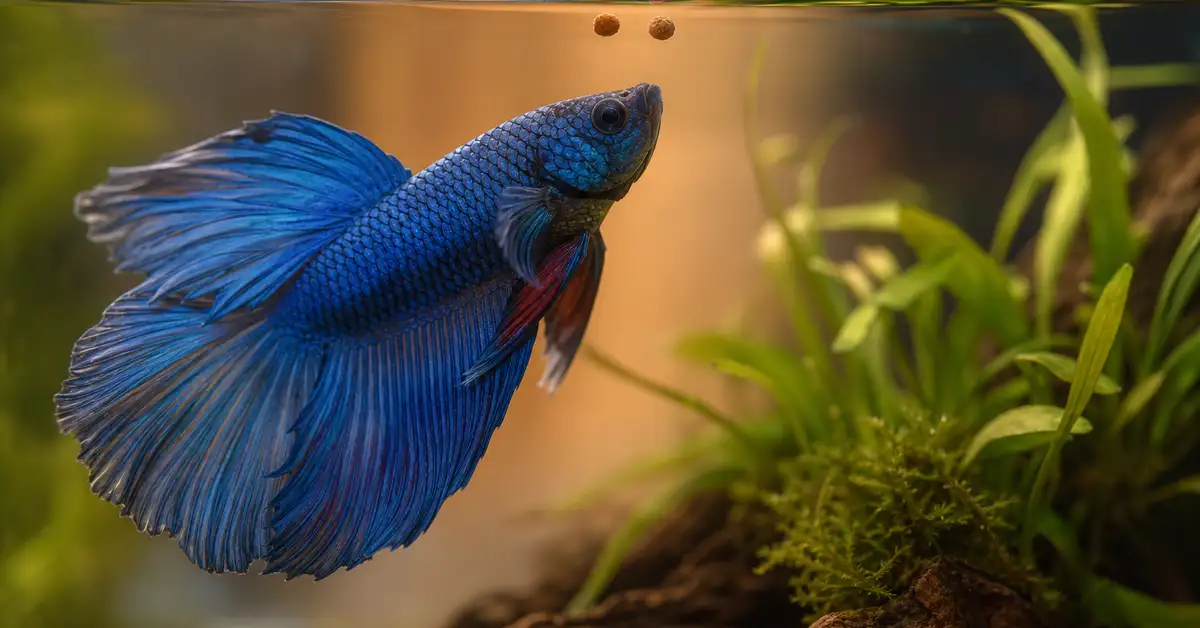
This is the most specific version of the feeding question, and it has a fairly narrow, well-sourced answer. Hikari, the manufacturer behind the widely-used Betta Bio-Gold line, publishes size-based counts on its own betta care sheet: bettas under 1.5 inches get six micro pellets twice a day, while bettas between 1.5 and 1.75 inches get three pellets up to three times daily, adding roughly one pellet per quarter inch of further growth — with a hard ceiling of five pellets in any single feeding. Bettafish.org, an independent betta-care resource, recommends a similar but slightly more conservative range: two to four pellets, once or twice a day, and explicitly warns against following package instructions that say to feed for three to five minutes, since that consistently overfeeds a betta’s genuinely small stomach.
Put together, a sensible working answer for a typical adult betta on modern, small-diameter pellets is two to four pellets per feeding, once or twice a day — a daily total in the region of four to eight pellets, not a small handful. Fluval’s feeding instructions for its Bug Bites Betta line skip a fixed count altogether and instead tell you to watch the fish’s belly: feed until it’s slightly curved, never a round ball, which is a useful cross-check regardless of which pellet count you start from. Betta stomachs are genuinely tiny — commonly described as roughly the size of the fish’s own eye — which is why “as much as it’ll eat” is the wrong instruction for this species in particular. If you’re setting up a betta tank for the first time, our complete betta fish care guide covers feeding alongside water parameters, tank size and tank mates.
Feeding bottom feeders, catfish and plecos
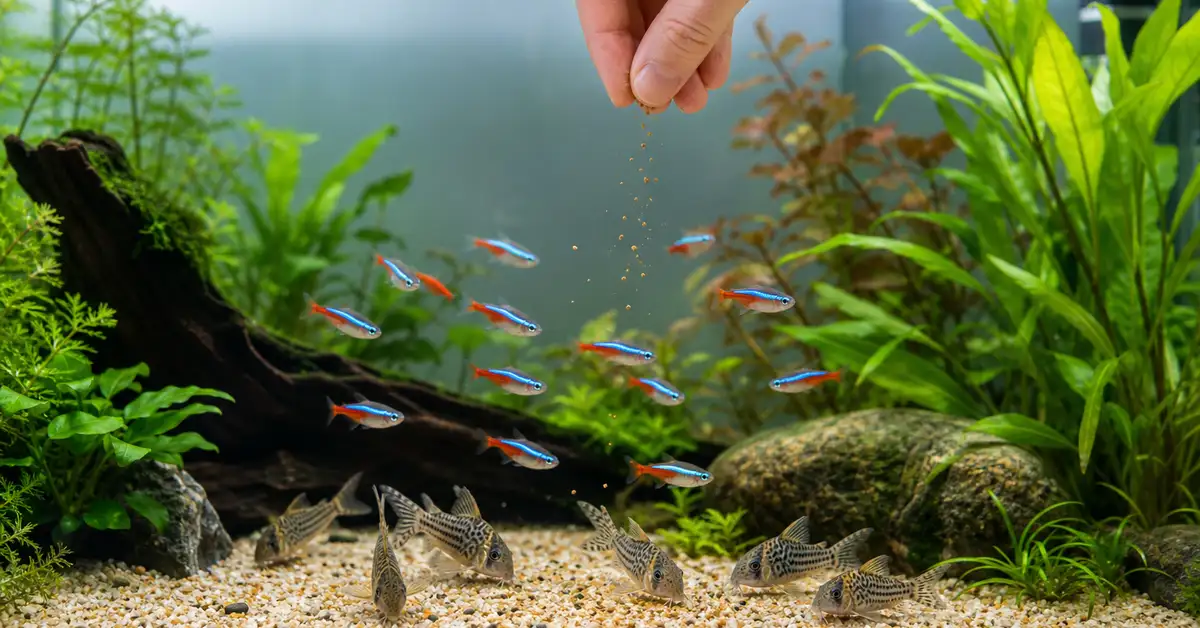
Corydoras catfish, small plecos and other bottom-dwelling scavengers need their own dedicated sinking food — wafers, granules or compressed tablets — because floating flakes eaten at the surface rarely reach the substrate in useful quantities. The RSPCA notes that middle- and bottom-dwelling species do best on quickly-sinking foods, and that nocturnal species such as many catfish should be fed last thing at night, once the tank’s lights are off, since that’s when they’re naturally active. Aquarium Co-Op makes the same point from a retail perspective: nocturnal fish like kuhli loaches and plecos can miss daytime feedings entirely if you don’t feed separately after lights-out.
In practice, that means feeding bottom feeders once daily or every other day, sized so the food is gone by the next morning with nothing persisting on the substrate. If wafers routinely go untouched, reduce the amount at the next feeding; if they disappear quickly and fish stay lean, you can increase slightly. Don’t rely on bottom feeders to “clean up” leftover surface food instead — reputable guidance is consistent that this just encourages chronic overfeeding of the whole tank rather than solving it.
Why overfeeding is the biggest beginner mistake
Fish rushing to the surface and gulping at food looks like hunger, and it’s tempting to read it that way — but it’s largely an opportunistic feeding instinct, not a reliable signal of how much a fish actually needs. Hikari’s own betta care sheet is blunt about the consequence: overfeeding is detrimental to water quality, and any uneaten food should be removed promptly to avoid ammonia buildup and cloudy water. The RSPCA is equally direct that fish are far more vulnerable to poor water quality than to being fed slightly too little.
The mechanism is straightforward once you see it. Uneaten food that sinks into the substrate or dissolves in the water becomes food for decomposing bacteria, and that process consumes oxygen while releasing ammonia — a compound that’s toxic to fish at very low concentrations. In an established tank, your biofilter converts that ammonia to nitrite and then to the far less harmful nitrate, but overfeeding can push ammonia in faster than the bacteria colony can keep up, especially in the smaller water volumes common in beginner setups and betta tanks. That’s exactly the chain our cycling guide and water parameters reference cover in more depth — feeding, cycling and water testing are really one system, not three separate topics.
The two-minute rule (and why a weekly fast day helps)
Across manufacturer instructions and animal-welfare guidance alike, one heuristic shows up again and again: feed only as much as your fish can finish in about two minutes, once or twice a day for most species. Fluval’s instructions for its Bug Bites lines use exactly this standard — feed what’s eaten in two minutes, two or three times daily, and use belly shape (slightly curved, never distended) as a secondary check. The RSPCA’s guidance allows a slightly wider two-to-five-minute window but makes the same underlying point: duration of active feeding, not a fixed volume of flakes, is the right way to size a portion.
A regular fast day — skipping one feeding day per week — is also common, well-tolerated advice, and it’s worth taking seriously rather than treating as optional. Bettafish.org builds a fast day into its recommended weekly betta schedule specifically to support digestion and reduce waste load, and Aquarium Co-Op notes that most healthy adult fish can comfortably go about a week without any food at all, depending on species and water temperature — which is useful context for exactly how little damage a missed feeding, planned or not, actually does. The point of a fast day is reduction, not compensation: don’t double up the portion the day before or after.
Feeding while you’re away: manual plans, auto-feeders and vacation blocks
For short trips, the simplest and safest option is often no feeding at all. Aquarium Co-Op notes that adult fish can typically go about a week without food depending on size and water temperature, which makes leaving a healthy, well-fed tank alone for a long weekend a reasonable default rather than a risk. For longer absences where someone else needs to feed the fish, pre-portioning is the detail that actually prevents problems — verbal instructions like “give them a pinch” invite generous scooping, while a labeled daily container or pill organizer removes the guesswork entirely. The RSPCA’s holiday guidance takes the same line: ask a responsible person to check the tank and equipment daily, and prepare meals in advance rather than leaving it to judgment in the moment.
Automatic feeders — programmable devices that dispense a measured amount of dry food on a schedule — can work well, but only once tested and calibrated over several days before you actually need them, not for the first time right before a trip. Dry pellets and granules tend to dispense more reliably than flakes, which can clump inside the mechanism. What we’d steer beginners away from are dissolving “vacation food” blocks: the RSPCA specifically cautions against them, since they release food continuously regardless of whether fish are hungry, and much of it tends to rot rather than get eaten — the opposite of the controlled, time-limited feeding this whole guide is built around.
Frequently Asked Questions
General information only — not veterinary advice. If your fish show ongoing signs of stress, illness or unusual behavior around feeding, consult an aquatic veterinarian.
Sources: Hikari USA: Betta Care Sheet · Hikari USA: Betta Bio-Gold · Bettafish.org: Best Betta Fish Food — What to Feed & How Much · RSPCA Surrey East: Caring for Your Fish · RSPCA Victoria: Fish · Aquarium Co-Op: How Often Do You Feed Fish (and How Much)? · PetSmart: Aquatic Pet Feeding Care Guide