To get rid of algae in a fish tank, first work out what kind of growth you have. Then remove what you can see by hand, and fix whatever is feeding it, which is usually too much light, too many nutrients or maintenance that has slipped. Algae is a sign of an imbalance, not a product problem. Aqueon, a major aquarium maker, says chemical control is only temporary if the cause stays in place. Below is the causes-first routine: how to identify the common types, a step-by-step cleanup, and where blackouts, UV sterilizers, algae-eating animals and algaecides fit, if they fit at all.
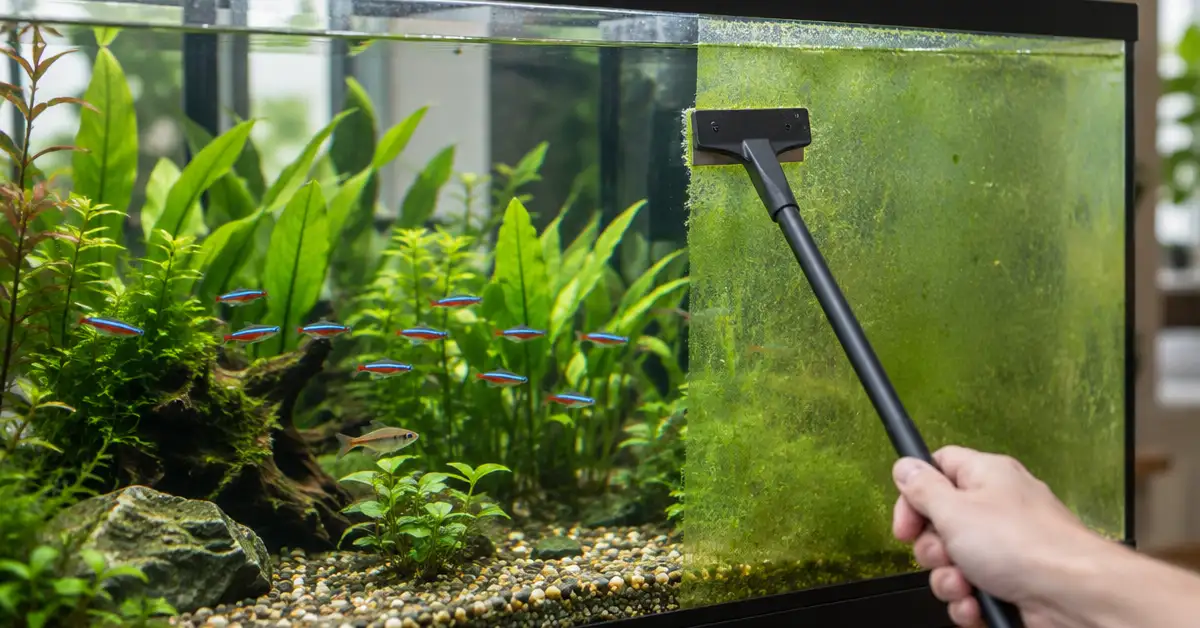
Why algae grows in a fish tank
Some algae is normal in any established aquarium. What deserves a closer look is growth that keeps spreading or keeps coming back. Aqueon’s nuisance-algae guide lists the usual causes. They tend to work together, so check all of them before you change anything:
- Light that runs too long or too bright. Count the hours your light is actually on, including any nights it was left running. Aqueon suggests a consistent timer with about 6–8 hours a day for tanks without live plants and 10–12 hours for planted tanks. Aquarium Co-Op suggests starting planted tanks at 6–8 hours. Use both as starting points and adjust to what your plants and your algae do.
- Direct sunlight. A window that puts sun on the tank for even part of the day can fuel a bloom. Shade the tank or move it.
- Extra nutrients. Uneaten food, fish waste, too many fish for the tank and filter, decaying plant matter, and water changes or filter maintenance that have fallen behind all add the nitrate and phosphate that algae feed on. Overfeeding is one of the easiest causes to fix. Our guide to feeding aquarium fish covers portion size, and our stocking guide covers how many fish a small tank can carry.
- Your tap water. Aqueon notes that some tap water carries nitrate and phosphate of its own, and that tap water high in silicate can feed brown diatoms. If algae keeps returning after water changes, test the tap water as well as the tank.
- A new tank. A brown, wipeable coating is common while a new aquarium matures. Green water in a brand-new tank can come with an ammonia spike, so check the cycle as well as the glass (see our guide to cycling a fish tank).
- Too few healthy plants. Live plants compete with algae for the same nutrients. Aqueon names fast growers such as hornwort and wisteria as useful competitors. The flip side, as Buce Plant points out, is that plants which are struggling for nutrients can leave the door open to algae. Starving the tank of fertilizer is not an automatic fix (our plant fertilizer guide covers the balance).
Aqueon publishes nitrate and phosphate targets, but its own guides give different figures depending on the article. Read them as guidance, not a single proven limit for every tank. What matters more is the trend in your own test results over time. Our aquarium water parameters guide explains how to read them.
Identify the type of algae first
The fix depends on where the growth is and what it looks like. These are visual cues for beginners, not lab identification. Aquarium Science notes that similar-looking coatings can be made up of different organisms.
- Green water. The water itself looks cloudy or pea-green because free-floating algae are suspended in it. Usual causes are too much light or direct light, extra nutrients, and in a new tank possibly an ammonia spike. Water changes alone often clear it only briefly.
- Green spot algae. Small, hard green dots stuck to the glass or to slow-growing leaves. Aquarium Co-Op links it to too much light or an imbalance of phosphate. An imbalance can mean too little as well as too much, so don’t strip phosphate on that basis alone. Scrape it off with a tool that suits your tank material.
- Green film or dust. A soft, even green haze across the glass rather than separate dots. Buce Plant ties it to a light period longer than the plants can use. Wipe it off during routine maintenance and check the timer.
- Brown algae (diatoms). A soft, dusty brown layer on glass, gravel or leaves, very common in young tanks. It wipes or siphons off easily and usually fades as the tank matures. If it hangs on, test your tap water for silicate.
- Black beard or brush algae. Stubborn dark gray, black or reddish fuzzy tufts on leaf edges, wood and decor. Sources don’t agree on one trigger. Buce Plant points to organic waste, lighting and unstable conditions in planted tanks, while Aqueon groups it with filamentous algae linked to phosphate buildup. Trim the worst leaves, scrub removable decor outside the tank, and work on the underlying routine.
- Hair or thread algae. Long green strands that tangle around plants and hardscape. Wind them onto an old toothbrush, siphon out the loose bits, and rebalance light, feeding and plant care.
- Blue-green “algae.” A spreading slime, blue-green or dark, over the substrate, plants or decor that sometimes smells. It isn’t true algae. It’s cyanobacteria, a bacterium that photosynthesizes. Aquarium Co-Op says its cause isn’t firmly established, but trapped debris and poor water flow are the usual suspects. Siphon it out, clear trapped waste, service the filter and improve circulation in dead spots. Algae-eating animals won’t clean it up for you.
How to get rid of algae in a fish tank, step by step
This is the non-chemical routine, roughly in the order you’d do it. It slots into a normal maintenance session. If you’re new to water changes, start with our step-by-step guide to changing aquarium water.
1. Check the fish and the water before the glass
If the outbreak comes with cloudy water, a newly set-up tank or fish that look stressed, test ammonia and nitrite as well as nitrate and phosphate. Then test your tap water the same way so you can compare the two. Algae can sit alongside a more urgent water-quality problem, and that problem comes first. Our aquarium test kits guide covers the options.
2. Unplug the heater and filter
Before you drain any water or take equipment out, unplug the heater and filter at the wall. Let the heater cool before you lift it out. Use buckets, sponges and brushes that are only ever used for the aquarium. Never use soap, dish detergent or household cleaners on anything that goes back in the tank. Aqueon and Tetra both warn that the residues can harm fish.
3. Remove what you can see
Use an algae pad or a magnetic cleaner for soft films on the glass, a scraper for hard green spots, an old toothbrush for long strands, and your siphon for loose growth and debris in the gravel. Trim plant leaves that are badly coated. Match the scraper to your tank: Aquarium Co-Op suggests a razor blade for glass tanks and an old plastic gift card for acrylic. Clean the glass first so whatever you knock loose gets siphoned out with the old water.
4. Do a modest water change, and keep doing them regularly
Siphon waste from the gravel as you drain. Then refill with temperature-matched, properly prepared replacement water. For a routine schedule, Aqueon offers about 10% weekly or 25% every two weeks as a starting point. Buce Plant suggests 20–30% weekly for managing algae in planted tanks. Pick a schedule you’ll actually keep. Steady upkeep matters more than one big cleanup.
5. Cut the extra nutrients without starving anything
Feed only what your fish finish in about two minutes, which is Aqueon’s rule of thumb, and remove leftovers. Take an honest look at how many fish are in the tank. Keep up with filter maintenance without scrubbing away the biological media (our filter-cleaning guide walks through it). In a planted tank, check whether the plants are actually growing before you cut fertilizer across the board.
6. Put the light on a timer and support the plants
A plug-in timer makes the photoperiod consistent and stops lights being left on overnight. Keep direct sun off the tank, and shorten the light period if algae keeps outpacing the plants. If your livestock and setup allow it, add some easy, fast-growing live plants to compete for nutrients (see our low-light aquarium plants guide for beginner-friendly options).
7. Give it time, and change one thing at a time
Algae that’s already in the tank won’t vanish overnight, even after you fix the cause. Keep removing it at each maintenance session, write down what you changed and when, and judge the result over a few weeks. If you change the light, the feeding and the fertilizer all in one week, you won’t know which change worked.
Blackouts and UV sterilizers: when they help
A blackout means covering the tank completely and leaving the light off, so the algae has no light to grow on. It is mainly used for green water and cyanobacteria, and sources disagree on how long it should last. For green water, Aqueon suggests a few days, while Aquarium Co-Op suggests at least a week. For cyanobacteria, Aquarium Co-Op discusses three to seven days. It also warns that plants can suffer, fish can get quarrelsome and the slime can come back. Keep the filter and aeration running throughout, check on the fish, and fix the trigger afterward. A blackout doesn’t replace regular upkeep.
A UV sterilizer exposes the water passing through its chamber to ultraviolet light. Aqueon says it can clear green water, because those algae float in the water column. It does nothing for algae already attached to glass, plants or decor, so keep working on light and nutrients even after the water clears.
Algae-eating fish, snails and shrimp: helpers, not a cure
Algae eaters graze on growth. They can’t fix too much light or too many nutrients, and every one of them needs a suitable tank, compatible tankmates and its own complete diet. Choose them for the adult animal and your tank size, not for the algae you see today.
- Nerite snails graze surface algae, including green spot. They need a secure lid, and tankmates that will leave them alone.
- Otocinclus graze soft films and diatoms. They’re social fish, so add them as a small group, and only to a mature, planted tank where they’ll find enough to eat. Your tank has to have room for the group.
- Amano shrimp can graze hair and thread algae. Keep them away from fish big enough to eat them. Some algae-control products are labeled unsuitable for tanks with shrimp, so check the label first.
- Bristlenose plecos are a smaller pleco option, but Aquarium Co-Op still recommends a tank of 25 gallons or more. They need their own food as well as whatever algae they find.
- A warning on “algae eater” names. Aquarium Co-Op describes the Siamese algae eater as an active fish that reaches about 6 inches, and says they can become semi-aggressive toward their own kind as they get older. It describes the Chinese algae eater as larger and more aggressive. Neither is a fix for a small beginner tank.
Because cyanobacteria is a bacterium, not true algae, none of these animals can be relied on to clear it.
Chemical algaecides: a last resort
Aqueon puts it plainly: chemical algaecides “should never be the first choice,” because they don’t address what caused the outbreak in the first place. If you do consider one after the steps above, read the specific product label against everything living in your tank. Aqueon, for example, says its own Algae Remover is not for aquariums with crustaceans, including shrimp. Follow the label, not directions from a forum post or an article, this one included.
“Liquid carbon” supplements are sometimes lumped in with algaecides, but the maker of one well-known product says otherwise. Seachem says of its Flourish Excel, “We do not produce or market it as an algicide,” and warns that excessive spot application can damage some plants.
Whatever caused a big die-off, don’t leave a large mass of algae to rot in the tank. Aqueon warns that sudden die-off can push ammonia and nitrite up, and decaying material also uses up oxygen. Remove as much as you can by hand, keep the water moving, and watch your fish closely for a few days.
Where the sources disagree
The published guidance isn’t unanimous, and we’d rather show you that than pick a number and present it as settled. Light-period suggestions for planted tanks range from 6–8 hours (Aquarium Co-Op) to 10–12 hours (Aqueon). Weekly water-change suggestions run from about 10% (Aqueon) to 20–30% (Buce Plant). Blackout lengths for green water run from a few days to at least a week. Black beard algae has no single agreed trigger. Our reading: start at the conservative end, change one thing at a time, and let your own tank’s response set the routine. Our low-tech vs. high-tech planted tank guide explains why brighter, faster setups need tighter control of light and nutrients.
Frequently Asked Questions
General information only, not veterinary advice. If your fish show ongoing signs of stress or illness, consult an aquatic veterinarian.
Sources: Aqueon: Prevention and Control of Nuisance Algae · Aqueon: Green Water — Causes and Cures · Aqueon: Algae Removers · Aquarium Co-Op: How to Fight 6 Types of Algae in Your Fish Tank · Aquarium Co-Op: How to Get Rid of Blue-Green Algae in Aquariums · Aquarium Co-Op: Top 5 Ways to Clean Algae from Your Fish Tank · Aquarium Co-Op: 10 Best Algae Eaters for Freshwater Aquariums · Aquarium Co-Op: Care Guide for Siamese Algae Eaters · Buce Plant: Algae in Aquariums · Buce Plant: Everything You Ever Wanted to Know About Algae in a Fishtank · Aquarium Science: “Brown Algae” · Seachem: Flourish Excel · Tetra: Aquarium Equipment Maintenance Tips