Most beginners do not need injected CO2 — ambient CO2 from fish respiration and the nitrogen cycle is enough for low-light, low-tech tanks, and a badly-managed CO2 system kills fish faster than no CO2 ever will. We say that plainly here, on the page selling CO2 hardware, because it is true and because getting it wrong is an acute, same-day risk, not a slow one. If you do need it — a high-light, densely-planted, fast-growth tank — we checked 14 real, currently-sold candidates across kits, regulators, adapters, diffusers, automation and liquid carbon. Nine made the cut below, spec-verified against each manufacturer’s own page and screened for CPSC recalls.
Five candidates we checked and didn’t publish
Five real, currently-sold products didn’t make this list, and we’re naming them rather than quietly dropping them. The CO2Art Pro-SE dual-stage regulator and the standalone GLA GRO regulator are excluded for redundancy — both are effectively the same core hardware as picks already below (CO2Art’s Pro-Elite and the GLA GRO System respectively), so listing them separately would pad the count without adding a genuinely different option. The Aquatek CO2 Regulator Mini, a popular paintball-tank regulator, is excluded because Aquatek of California’s own manufacturer website is currently offline (the domain has lapsed), leaving only marketplace listings to source its pressure specs — and marketplace listings are exactly where CO2 regulator pressure claims tend to be wrong, so we won’t publish a spec we can’t verify against the manufacturer itself. ADA’s Pollen Glass Beetle diffuser is excluded for the same in-tank-diffuser redundancy as above, and because we could only find it hosted by an authorized distributor, not by ADA directly. And the Aquarium Co-Op CO2 Regulator, a well-regarded dual-stage unit we considered early, turned out to be discontinued — Aquarium Co-Op’s own product-support page states plainly that “this product is no longer being sold.” Our October 2026 CPSC search found no recall behind that, only a business decision, but a discontinued product doesn’t belong in a current buying guide.
Most beginners should start without injected CO2
Every plant we recommend in our beginner plant guide and most of the picks in our low-light plants guide grow well under a standard kit light with zero supplemental CO2. Injected CO2 becomes the relevant bottleneck only once you’re running higher light for longer periods and want the fast growth and dense carpets that define a “high-tech” aquascape — and at that point, light and CO2 usually need to be solved together, not CO2 alone. If your plants are pale or stalling, check light and photoperiod first, then nutrients (see our fertilizer guide) before assuming CO2 is the fix. Adding pressurized CO2 to a tank that doesn’t need it adds real risk — to your fish, not just your wallet — for a growth benefit you may not be chasing yet.
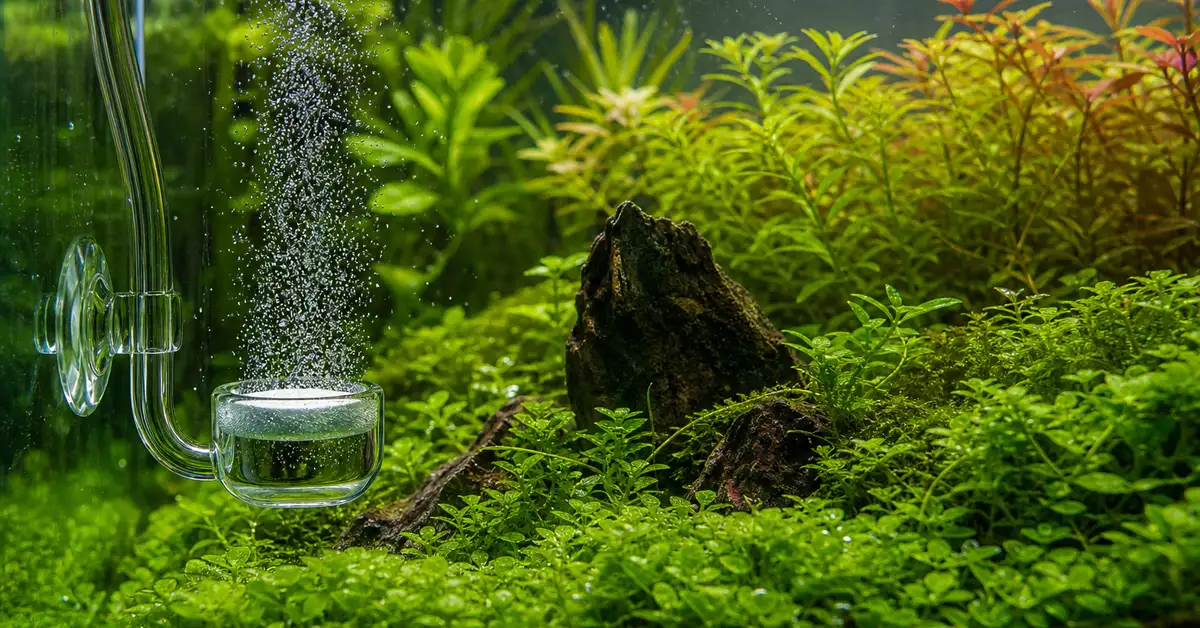
Dual-stage vs. single-stage regulators — the difference that matters as the cylinder empties
A CO2 regulator’s job is to take cylinder pressure (hundreds of PSI) and step it down to a stable working pressure a diffuser can use safely. A single-stage regulator does this in one step; as the cylinder empties and internal spring tension changes, output pressure can drift upward — a failure mode the industry calls “end-of-tank dump,” where a near-empty cylinder briefly delivers far more CO2 than intended. A dual-stage regulator reduces pressure in two steps specifically to prevent that drift, keeping output pressure stable from a full cylinder to a nearly empty one. Multiple manufacturers we checked (CO2Art, Green Leaf Aquariums) describe dual-stage construction in almost identical terms for exactly this reason. Single-stage regulators aren’t unsafe — they’re standard on most beginner-kit CO2 systems, including one of our own picks below — but they ask more of you: replace the cylinder before it runs fully empty, and don’t treat a single-stage regulator as “set and forget” the way you might a dual-stage one. CGA-320 is the standard male thread fitting for most refillable aquarium and homebrew/beverage-gas CO2 cylinders sold in the US; if a regulator or adapter doesn’t list CGA-320 compatibility explicitly, don’t assume it fits.
CO2 safety: what can actually go wrong, and how to prevent it
This is the single most important section on this page. CO2 overdose is an acute livestock-safety issue, not a slow one — a fish tank can go from fine to a mass casualty event in a matter of hours if a regulator is left wide open or a solenoid fails to shut off overnight.
Gas-off symptoms to watch for: fish gasping at the surface, clustering near a filter outflow or airstone (where oxygen is locally higher), rapid or labored gill movement, loss of balance, or lying unresponsive on the substrate. If you see any of this, increase surface agitation immediately and shut off the CO2 supply.
Surface agitation is your first and fastest safety mitigation. A filter outflow that breaks the surface, an airstone, or a wavemaker increases gas exchange with the atmosphere, which helps push excess dissolved CO2 back out of the water and pull oxygen in. It’s a genuine safety margin, not just an aesthetic choice, and it’s one you can increase in seconds if something looks wrong.
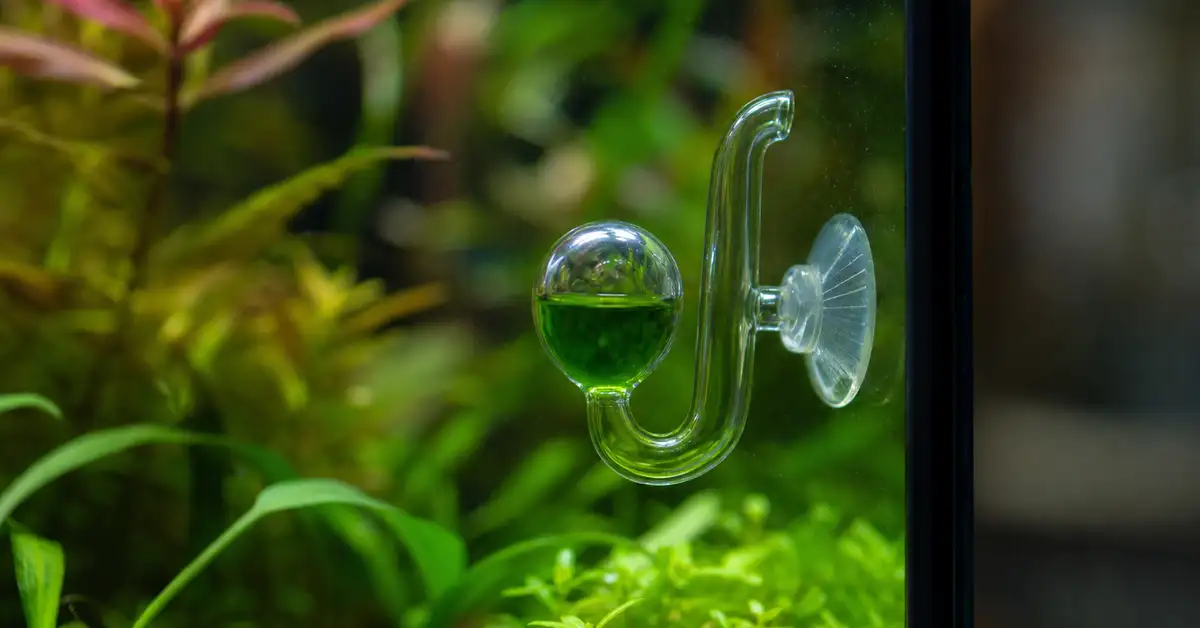
Drop checkers have real limits — know them before you trust one. A drop checker’s indicator fluid changes color as CO2 equilibrates across an air gap with the tank water, and that equilibration is slow: the color you see can lag actual tank conditions by an hour or more. A “green” drop checker during a bubble-rate change you made 20 minutes ago is telling you about the past, not the present. Use a drop checker to tune a stable, unchanging setup over several days — not as an emergency readout.
Night-time shut-off matters because plants stop consuming CO2 in the dark. Every regulator we recommend below with an integrated solenoid is designed to be wired to a timer (or a light-linked smart plug) so CO2 injection stops before lights-out and resumes shortly before lights-on, matching the photosynthesis cycle rather than dosing CO2 around the clock into water that, overnight, can’t use it.
Never leave a newly set-up CO2 system unattended for its first full day-night cycle. Bubble rate, diffusion efficiency, and your specific tank’s circulation all interact in ways you can’t fully predict from a chart. Start low, watch your fish for the first several hours after CO2 starts, watch again through the first night if you can, and only move to unattended, timer-driven operation once you’ve confirmed the system behaves the way you expect across a full cycle.
General information only, not veterinary or aquatic-health advice — if you have concerns about a specific animal’s health or a tank that already looks like it’s in distress, consult an aquatic veterinarian or an experienced local fish health resource rather than waiting on a forum reply.
Liquid carbon vs. injected CO2 — what it is, and what it deliberately isn’t
Liquid carbon products (Seachem Flourish Excel and similar) supply plants with organic carbon compounds they can use as photosynthetic intermediates — a real, manufacturer-documented alternative carbon pathway, not a placebo. But Seachem’s own materials are explicit that CO2 injection produces quantitatively more growth than liquid carbon alone; it is a genuine complement or a workable substitute in low-to-moderate light tanks, not an equivalent swap for pressurized CO2 in a high-light, high-tech aquascape. We cover it as pick 9 below, framed honestly both ways: real benefit, real limit.
Inline atomizers, in-tank diffusers, and reactors — the diffusion side of the system
Once CO2 is flowing at a safe, stable rate, it still has to actually dissolve into the water column rather than bubbling straight to the surface and off-gassing uselessly. In-tank diffusers (pick 7 below) sit inside the aquarium and break gas into fine bubbles via a ceramic or acrylic diffusion disk. Inline atomizers mount on a filter’s return line outside the tank and micro-atomize CO2 directly into the outflow, typically needing a higher working pressure (commonly cited as 30–50 PSI) than an in-tank diffuser to perform well — we did not find a standalone inline atomizer we could spec-verify against its own manufacturer’s page in time for this build, and we’d rather say that plainly than publish an unverified pressure figure (see “What we can’t verify” below). CO2 reactors take a third approach, holding gas in a chamber with moving water for a longer contact time; pick 8 below (JBL’s ProFlora set) bundles one.
Last updated August 2026. This guide sits alongside our beginner plants guide and low-light plants guide (know whether you need CO2 before you buy it), our fertilizer guide (light and CO2 are usually the real bottleneck before nutrients are), our water parameters reference (CO2 injection lowers pH — know your baseline first), and our substrate guide. Ready to actually put a scape together before deciding on CO2? See our how to aquascape a planted tank guide for the hardscape-to-planting build order. Full method: How We Choose. This page contains affiliate links; see our affiliate disclosure for how that works.
Quick comparison
| Product | Type | Beginner-friendly? | Best for | Price band |
|---|---|---|---|---|
| 1. GLA GRO Aquarium CO2 System | Complete kit (single-stage + cylinder) | Yes | Complete beginner kit, single tank | $$$ |
| 2. Fluval Mini Pressurized CO2 Kit (20g) | Disposable cartridge kit | Yes | Nano tanks up to 15 gal, no cylinder commitment | $ |
| 3. CO2Art Pro-Elite Series V2 Regulator | Dual-stage regulator | No | Premium standalone build, high pressure ceiling | $$$ |
| 4. GLA PRO-DS-2 Dual Stage Regulator | Dual-stage regulator, 2-tank manifold | No | Multi-tank / expandable setups | $$$ |
| 5. FZONE Mini Dual Stage Regulator (FZ-1011) | Dual-stage regulator, paintball-compatible | Somewhat | Budget regulator build, paintball or CGA-320 tanks | $$ |
| 6. CO2Art Pro-Series CO2 Adapter | Cylinder adapter | No (add-on) | Using paintball/SodaStream/disposable bottles with an existing regulator | $ |
| 7. Aquario Neo CO2 Diffuser | In-tank diffuser | Yes (add-on) | In-tank diffusion, break-resistant acrylic | $ |
| 8. JBL ProFlora CO2 Professional Set V | Automated kit w/ CO2/pH computer + reactor | Somewhat | Hands-off automated dosing, larger tanks | $$$ |
| 9. Seachem Flourish Excel | Liquid carbon supplement | Yes | No hardware, low-to-moderate light tanks | $ |
The 9 best CO2 systems for planted tanks (2026)
Transparency first: This guide contains affiliate links. If we’re enrolled in an affiliate program, we may earn a commission at no extra cost to you — it never affects how we research or rank. Read our full affiliate disclosure policy.
1. GLA GRO Aquarium CO2 System — Best Complete Beginner Kit
The GLA GRO System pairs Green Leaf Aquariums’ single-stage GRO regulator with a 5 lb aluminum CO2 cylinder, CO2-resistant tubing, and a tank seal — everything a first-time CO2 buyer needs except a diffuser and a filled cylinder. It’s a genuine single-purchase entry point into refillable CGA-320 cylinder infrastructure, rather than a disposable-cartridge system you’ll outgrow.
Best for: a first CO2 system for a single tank, for buyers who want to commit directly to a refillable cylinder rather than disposable cartridges.
Key specs: single-stage regulator · CGA-320 installation (standard US CO2 cylinders) · 0–70 PSI output pressure range · integrated solenoid and bubble counter with check valve · 5 lb aluminum cylinder ships empty, fill locally.
Pros: one purchase covers regulator, cylinder and tubing; CGA-320 means easy local refills; manufacturer states a limited lifetime warranty on the regulator against manufacturing defects.
Cons: single-stage design means output pressure can drift as the cylinder nears empty — replace before it runs fully dry; still need to buy a diffuser or reactor separately; single-aquarium only (GLA sells a separate splitter add-on for multi-tank use).
Price band: $$$ · Evidence: existence and specs verified directly on greenleafaquariums.com (manufacturer’s own product page); no recall found for this product in our October 2026 CPSC search.
2. Fluval Mini Pressurized CO2 Kit (20g) — Best No-Cylinder Starter Kit
Fluval’s Mini kit uses a disposable, non-refillable 20g CO2 cartridge rather than a refillable cylinder, paired with a simple regulator valve and a small internal ceramic diffuser. It’s the lowest-commitment way to try injected CO2 on a nano tank without buying into cylinder infrastructure at all.
Best for: nano and small planted tanks up to about 15 US gallons, or anyone who wants to try CO2 before committing to a refillable-cylinder system.
Key specs: 20g disposable, non-refillable CO2 cartridge · rated for aquariums up to 15 US gal / 57 L · includes bracket, regulator valve, hose and internal ceramic diffuser · regulator valve covered by a 2-year manufacturer warranty against defects.
Pros: genuinely simple to install, no cylinder refill logistics, cheap way to try whether CO2 helps your specific tank.
Cons: cartridges are disposable and non-refillable, so per-dose cost is higher than a refillable cylinder long-term; not CGA-320 compatible, so it doesn’t grow with you into a bigger regulator/cylinder build; Fluval’s own manual explicitly warns against using the cartridge with unrelated pressurized devices like tire inflators or soda-bottle carbonators — it’s built for this one job only.
Price band: $ · Evidence: specs, capacity rating and safety warnings verified directly against Fluval’s (Rolf C. Hagen) own instruction manual, hosted on fluvalaquatics.com; no recall found for this product in our October 2026 CPSC search.
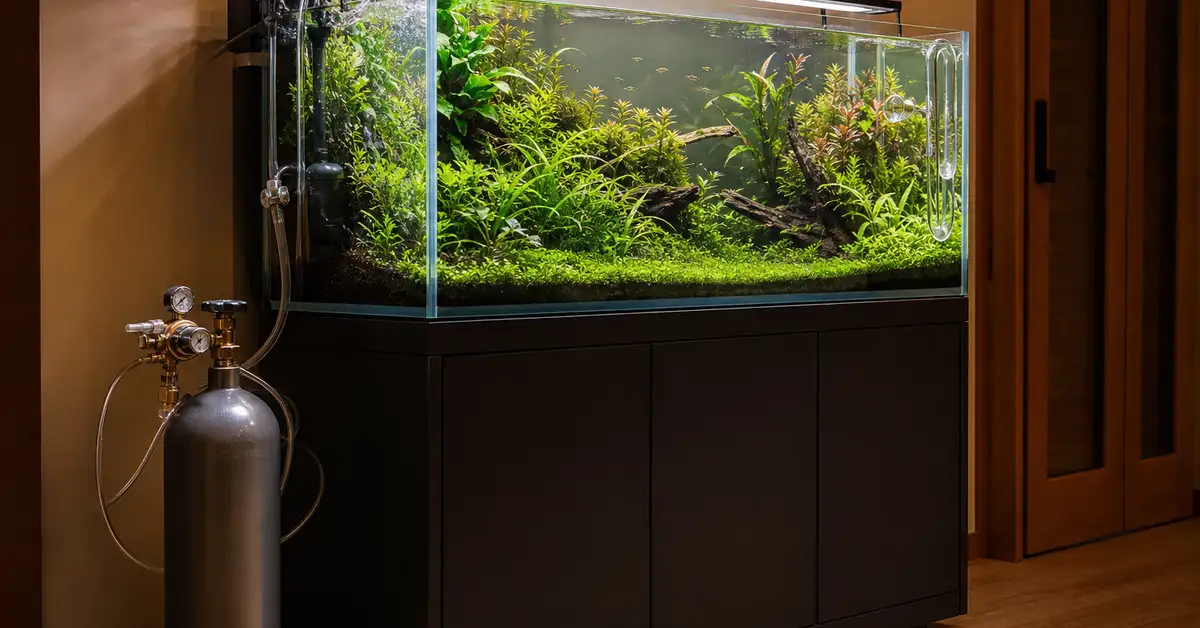
3. CO2Art Pro-Elite Series V2 Dual Stage Regulator — Best Premium Standalone Regulator
CO2Art’s Pro-Elite is a dual-stage regulator built for aquariums from 5 to 5,000 liters, with a fully customized solenoid block, integrated needle valve and bubble counter, and a working pressure ceiling high enough for demanding inline atomizers as well as standard in-tank diffusers.
Best for: a premium standalone regulator for a single high-tech tank, or as the anchor of a multi-outlet build via CO2Art’s optional manifold block.
Key specs: dual-stage pressure reduction · adjustable working pressure up to 5 bar (≈72.5 PSI) · thread options for BS341/DIN477/W21.8×14 or CGA-320 · integrated 12V DC solenoid, needle valve and bubble counter with check valve, extendable manifold block available.
Pros: dual-stage construction is explicitly designed to prevent end-of-tank pressure dump regardless of cylinder size; high working pressure ceiling supports inline atomizers as well as in-tank diffusers; universal 100–240V power adapter.
Cons: premium price for a regulator alone, with cylinder, diffuser and tubing all sold separately; CGA-320 is an option on this model rather than the only thread offered, so double-check you’re ordering the North American variant.
Price band: $$$ · Evidence: specs verified directly on co2art.eu (manufacturer’s own product page); no recall found for this product in our October 2026 CPSC search; no documented pressure-creep or dump-failure history found in reputable aquascaping sourcing for this specific model.
4. GLA PRO-DS-2 Dual Stage Regulator — Best for Multi-Tank Manifold Setups
The PRO-DS-2 is Green Leaf Aquariums’ modular dual-stage regulator, built around a 2-block manifold so a single regulator can feed two aquariums with independently adjustable needle valves per line. Additional blocks can be added later (GLA sells the same platform in 1- through 6-block configurations) as a setup grows.
Best for: aquascapers running two or more high-tech tanks off one CO2 source, or anyone who expects to add a second tank later.
Key specs: dual-stage pressure reduction · CGA-320 installation · 0–140 PSI output pressure range · 2-block modular manifold with independent needle valve per line, expandable to additional blocks · integrated pressure relief valve.
Pros: genuinely independent control per tank rather than a single shared valve; dual-stage design plus manufacturer-stated limited lifetime warranty; expandable without replacing the core regulator.
Cons: the modular manifold system is proprietary to GLA’s PRO-DS regulators and isn’t cross-compatible with other brands’ manifolds; regulator only, no cylinder included; overkill if you only run one tank (see pick 1 or 3 instead).
Price band: $$$ · Evidence: specs verified directly on greenleafaquariums.com (manufacturer’s own product page); no recall found for this product in our October 2026 CPSC search.
5. FZONE Mini Dual Stage CO2 Regulator (FZ-1011) — Best Budget Regulator, Paintball-Compatible
FZONE’s own product page names this a dual-stage regulator, though its description also refers to the internal design as “triple-stage” — either way, it is a multi-stage design, not a single-stage one, at a price well below CO2Art’s or GLA’s dual-stage models. It’s notable for explicit compatibility with paintball CO2 tanks alongside standard CGA-320 cylinders, covering the paintball-tank use case directly from the regulator side rather than requiring a separate adapter.
Best for: a budget-conscious first standalone regulator, especially for anyone using a paintball CO2 tank rather than a standard aquarium/beverage-gas cylinder.
Key specs: manufacturer-described dual/multi-stage pressure reduction · adjustable working pressure 0–60 PSI · compatible with paintball tanks, CGA-320 cylinders, and 5/8″ UNF disposable 80–90g cartridges · explicitly not compatible with Fluval’s 45g 3/8″-threaded cartridges · 12V DC solenoid and integrated needle valve.
Pros: genuinely budget-priced for a multi-stage regulator; paintball compatibility built in rather than bolted on; manufacturer’s own spec page explicitly lists what it does and doesn’t fit, rather than a vague “universal” claim.
Cons: far less established brand history than CO2Art or GLA in reputable aquascaping sourcing; lower maximum working pressure (60 PSI) than the premium dual-stage options above, which may limit some inline-atomizer setups.
Price band: $$ · Evidence: specs verified directly on fzaqua.com (FZONE’s own manufacturer site); no recall found for this product in our October 2026 CPSC search.
6. CO2Art Pro-Series CO2 Adapter — Best Adapter for Paintball, SodaStream or Disposable Bottles
This adapter doesn’t replace a regulator — it lets an aquarium regulator built for one cylinder thread connect to a different bottle type: paintball tanks, SodaStream-style cylinders, or disposable CO2 bottles. If you already own (or are buying) a CGA-320 or W21.8-threaded regulator and want to use a non-standard cylinder with it, this is the piece that bridges the gap.
Best for: pairing an existing standard-thread regulator with a paintball tank, SodaStream cylinder, or disposable bottle instead of a full aquarium cylinder.
Key specs: adapter only, not a regulator · variants for Sodastream (W21.8×14 or CGA-320 outlet), paintball (BS341/DIN477/W21.8×14 or CGA-320 outlet), and disposable bottles · adjustable precision ON/OFF pin valve · elbow design for correct horizontal regulator installation · anti-corrosion materials.
Pros: genuinely opens up cheaper or more convenient cylinder sources without replacing a regulator you already like; the ON/OFF pin valve gives an extra manual shut-off point independent of the regulator; low cost relative to any regulator on this list.
Cons: you must match the correct thread variant to both your cylinder and your regulator, which takes a moment of care; it’s one more mechanical joint and seal in the gas path, so leak-check with soapy water after installation.
Price band: $ · Evidence: specs verified directly on co2art.eu (manufacturer’s own product page); no recall found for this product in our October 2026 CPSC search.
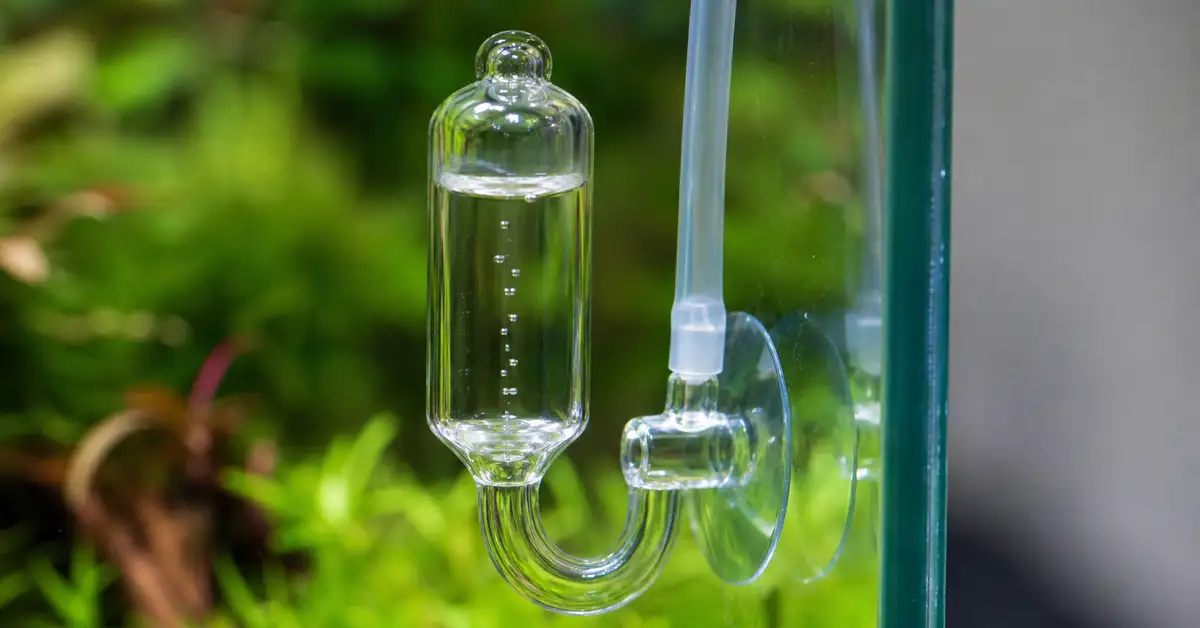
7. Aquario Neo CO2 Diffuser — Best In-Tank Diffuser
The Aquario Neo uses a small ceramic diffusion disk housed in a break-resistant acrylic body rather than glass, breaking CO2 into a fine mist of bubbles for faster dissolution into the water column. Aquarium Co-Op, the specialist retailer we sourced this pick’s specs from, calls it their favorite CO2 diffuser for exactly this combination of fine bubbles and durability during routine tank maintenance.
Best for: in-tank diffusion for most planted tank sizes, especially if you’ve broken a glass diffuser before during cleaning or maintenance.
Key specs: ceramic diffusion disk in an acrylic body · requires an external pressurized CO2 source · suction-cup mounted · manufacturer/retailer recommends soaking the ceramic disk in water for about 30 minutes before first use so it produces fine bubbles immediately.
Pros: genuinely more durable than a glass diffuser for the same job; produces a fine bubble mist rather than large, slow-dissolving bubbles; simple, low-cost add-on to any of the regulators above.
Cons: in-tank diffusers are visible equipment inside the aquascape, unlike an inline atomizer mounted outside the tank; ceramic disk performance can degrade with algae buildup over time and needs occasional cleaning.
Price band: $ · Evidence: we could not find a page hosted directly by Aquario (the manufacturer) itself, so specs are sourced to Aquarium Co-Op’s own product page as an authorized US specialty retailer, flagged here rather than presented as manufacturer-direct; no recall found for this product in our October 2026 CPSC search.
8. JBL ProFlora CO2 Professional Set V — Best Automated pH-Controlled System
JBL’s Professional Set V is built around a CO2/pH computer that measures pH via a probe and automatically adjusts the solenoid to hold a target CO2 level, rather than relying on a fixed bubble-per-second rate that never adjusts itself. It bundles the pressure reducer, solenoid, bubble counter with check valve, hose, and a Taifun Spiral CO2 reactor — the closed-loop automation and reactor-based diffusion this page’s ladder calls for in one package.
Best for: aquarists who want CO2 dosing tied to an actual water-chemistry measurement rather than a static bubble rate, in tanks from 40 to 600 liters.
Key specs: working pressure adjustable up to 1.2 bar (≈17.4 PSI), with an integrated safety valve that vents gas if pressure exceeds design limits · fits both JBL reusable cylinders (W21.8×1/14 thread) and disposable cylinders (M10x1 thread), with an adapter included for the reusable format · pH probe and CO2 cylinder are not included and must be bought separately.
Pros: genuine closed-loop pH-based control rather than just a timer; integrated mechanical safety valve is an extra layer beyond the solenoid; includes a reactor, so diffusion hardware isn’t a separate purchase.
Cons: highest price on this list, before you’ve even added the required pH probe and cylinder; JBL’s own thread standards (W21.8×1/14 and M10x1) are not CGA-320, so North American buyers need to confirm cylinder sourcing before ordering; a pH probe needs periodic calibration to stay accurate, which is one more maintenance task than a plain solenoid-and-timer setup.
Price band: $$$ · Evidence: specs verified directly on jbl.de (manufacturer’s own product page, item no. 6464200); no recall found for this product in our October 2026 CPSC search.
9. Seachem Flourish Excel — Best Liquid Carbon Alternative (Not a CO2 Substitute)
Flourish Excel supplies plants with bioavailable organic carbon compounds — structurally similar to natural photosynthetic intermediates — as an alternative or complement to CO2 injection, not a disguised version of it. Seachem’s own materials are direct about the tradeoff: dosed alone, it provides real, substantial growth benefit, but quantitatively less than injected CO2 in a high-light tank. It’s also useful specifically where continued CO2 dosing risks pushing pH dangerously low, since Excel has no pH impact at all.
Best for: low-to-moderate light tanks that don’t want hardware at all, or as a genuine complement to CO2 injection in a high-light tank where you don’t want to push CO2 any harder.
Key specs: bioavailable organic carbon source, not gaseous CO2 · no direct pH impact · dosing: 5 mL per 40 L (10 US gal) on initial use or after a large water change, then 5 mL per 200 L (50 US gal) daily or every other day · sold in 50 mL through 4 L sizes · manufacturer states it is safe for fish when used as directed.
Pros: zero equipment cost or complexity; manufacturer explicitly states surface agitation does not reduce its effectiveness, unlike injected CO2; can be dosed at any time of day and remains available to plants for about 24 hours.
Cons: Seachem’s own comparison puts CO2 injection ahead of Excel alone for raw growth (“if CO2 is a 10, Flourish Excel is a 6-7”); some sensitive plants and marimo moss balls can react to overdosing, and Vallisneria can show temporary leaf melt at doses above the label rate; ongoing bottle cost adds up over time compared with a one-time hardware purchase.
Price band: $ · Evidence: dosing, mechanism and safety claims verified directly on seachem.com (manufacturer’s own product page); no recall found for this product in our October 2026 CPSC search.
How to actually choose, in one paragraph
If you’re not sure you need CO2 at all, you probably don’t yet — revisit our beginner and low-light plant guides first. Want the simplest possible first CO2 system on a single tank and are ready to commit to a refillable cylinder: the GLA GRO System (pick 1). Want to try CO2 on a nano tank with zero cylinder commitment: the Fluval Mini Kit (pick 2). Building a premium standalone regulator setup, possibly with an inline atomizer down the line: CO2Art’s Pro-Elite (pick 3). Running, or planning to run, more than one high-tech tank: the GLA PRO-DS-2 (pick 4). On a tight budget or already own a paintball CO2 tank: the FZONE FZ-1011 (pick 5), or add the CO2Art adapter (pick 6) to a regulator you already own. Need an in-tank diffuser that won’t shatter during a routine clean: the Aquario Neo (pick 7). Want CO2 dosing tied to an actual pH measurement rather than a fixed bubble rate, and don’t mind the price and the extra pH-probe maintenance: JBL’s Professional Set V (pick 8). Want real plant-growth benefit with no hardware at all, or a safety-margin complement to CO2 you’re already running: Seachem Flourish Excel (pick 9).
What we can’t verify
We did not find a standalone inline CO2 atomizer product we could spec-verify against its own manufacturer’s page in time for this build — inline atomizers are covered conceptually in the explainer section above, but we’re not naming a specific inline-atomizer pick rather than publishing a pressure or performance figure sourced only to a marketplace listing. Burst/failure pressure ratings are not published by CO2Art, GLA, FZONE or JBL on any of the product pages we checked for this guide; we report the working pressure ranges they do publish and note where burst-pressure data simply isn’t available rather than estimating it. We found no documented pressure-creep, leak or “dump” failure history in reputable aquascaping sourcing for any regulator on this list as of our research date — that’s a genuinely reassuring finding, not a guarantee, and it does not substitute for the start-up supervision described in the safety section above. Aquario’s diffuser specs are sourced to an authorized US specialty retailer rather than a page hosted directly by Aquario, flagged in that pick’s evidence line. Cylinder hydro-test/retest intervals are set by the cylinder’s country-specific transport regulator (DOT in the US) rather than by any of the equipment brands on this page, and we have not independently verified specific retest dates for any individual cylinder SKU — check the stamped date on the cylinder you actually receive.
Frequently Asked Questions
General information only, not veterinary or aquatic-health advice — if you have concerns about a specific animal’s health, consult an aquatic veterinarian. Manufacturer specs and prices can change between our research date and your purchase; always confirm current specs on the retailer or manufacturer listing before buying.
Sources: Seachem: Flourish Excel Product Page · CO2Art: Pro-Elite Series V2 Dual Stage Regulator · CO2Art: Pro-Series CO2 Adapter · Green Leaf Aquariums: GLA GRO Aquarium CO2 System · Green Leaf Aquariums: GLA PRO-DS-2 Dual Stage Regulator · FZONE (Fzone Studio): Mini Dual Stage CO2 Regulator (FZ-1011) · JBL: ProFlora CO2 Professional Set V · Fluval (Rolf C. Hagen): Mini Pressurized CO2 Kit Instruction Manual · Aquarium Co-Op: Aquario Neo CO2 Diffuser Product Page · Aquarium Co-Op: CO2 Regulator Discontinuation Notice · US CPSC: Recalls (October 2026 search; no recall found for any recommended product)