A partial water change is the single most important routine maintenance task in a freshwater aquarium — more important than any gadget or product. Most normally-stocked community tanks do well with a 10-25% water change every one to two weeks, using a gravel vacuum to lift waste from the substrate and temperature-matched, dechlorinated water to refill. Here’s the honest, step-by-step version, plus how the routine changes for heavier stocking, nano tanks, and a fish-in cycle.
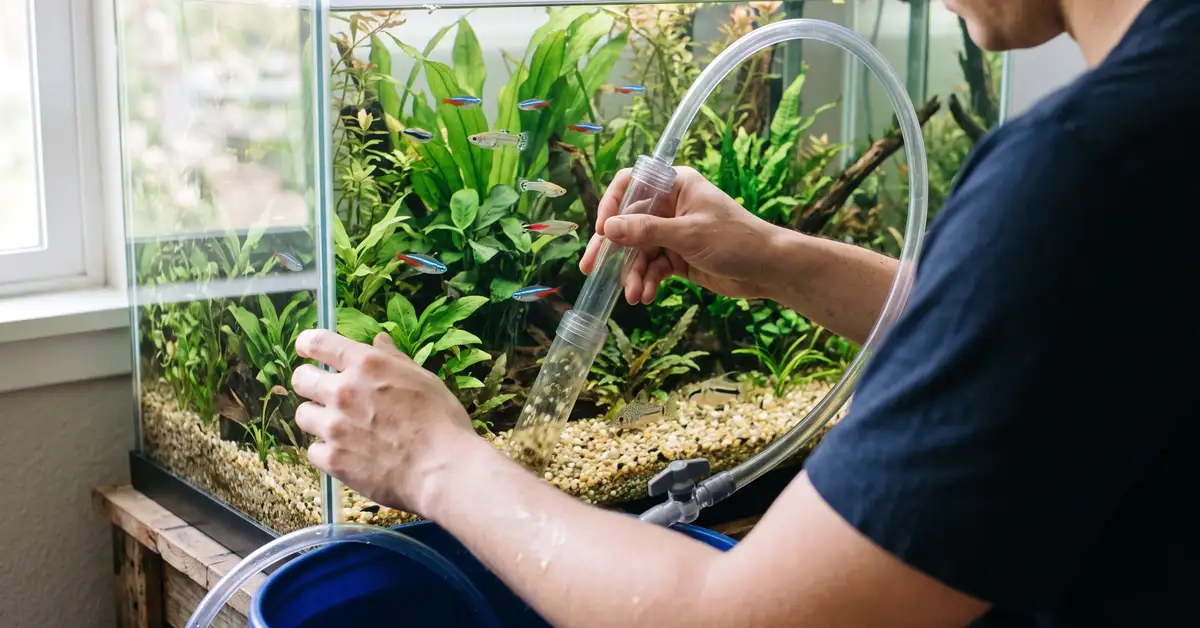
Why partial water changes matter
Your filter’s bacteria handle the toxic part of the nitrogen cycle — converting ammonia into nitrite, then nitrite into the far less harmful nitrate (see our full guide to cycling a fish tank for how that colony gets established). What the filter doesn’t do is remove that nitrate once it’s formed, along with dissolved organic waste and the trace minerals and buffering capacity your water slowly loses over time. A partial water change is what handles all of that — diluting nitrate back down, exporting dissolved waste, and topping up the minerals that keep pH stable. For the full reference chart on safe ranges at every stage, see our aquarium water parameters guide.
How often should you change the water?
For a normally-stocked freshwater community tank, aquarist educators including Aquarium Co-Op and Aqueon converge on roughly 10-25% (some recommend up to 30%) every one to two weeks as the standard baseline, adjusted up or down based on how quickly your own tank’s nitrate climbs between changes. Stocking and species change that number a lot: a single, lightly-fed betta can often stretch to every two to four weeks, while heavily-stocked, messy, or heavily-fed tanks — and species like goldfish or larger cichlids — commonly need 25-50% weekly, sometimes split across two sessions. Small tanks foul fastest of all: a nano tank under about 10 gallons can need attention every few days rather than weekly. Our stocking guide and our 5-gallon and 10-gallon stocking guides all affect where you land in that range — the more fish and the more bioload, the more often you’ll need to change water, regardless of tank size.
If you’re mid fish-in cycle, throw the calendar out entirely: let your test kit set the schedule. Ammonia or nitrite readings above roughly 0.25-0.5 ppm call for an immediate 25-50% water change to dilute them back down, not a wait for your usual day. Skipping changes during this window is exactly how new tank syndrome happens — see our cycling guide for the full fish-in safety approach.
1. Test your water and gather supplies first
Before you touch the tank, test ammonia, nitrite, nitrate and temperature with a liquid reagent kit (see our best aquarium test kits guide if you need one) so you know your starting point and can judge whether this session needs to be bigger than usual. Gather a bucket dedicated to aquarium use only (never one that’s held soap or cleaning chemicals), a gravel vacuum/siphon, a thermometer, and your water conditioner.
2. Turn off and unplug the heater and any submerged equipment
Do this before you drain a single drop. A heater left running as the water level drops below it can crack from the temperature difference, and it’s a genuine shock risk once exposed to air — unplug it at the wall, not just at a switch. Turn off filters and powerheads too, both to avoid running them dry and to stop them fighting the water level as it drops.
3. Clean the glass, then gravel-vac part of the substrate
Scrape or magnet-clean algae off the glass first so the dislodged debris gets siphoned out with the old water rather than resettling. Then work the gravel vacuum into the substrate in sections — press the wide end into the gravel to lift trapped waste while letting the gravel itself fall back. Clean roughly a third to half of the bed per session and rotate which section you cover each time, rather than vacuuming the entire substrate at once; the gravel and filter media both host the bacteria colony from your cycle, and stripping all of it in one go can knock that colony back.
4. Drain your planned percentage
Keep siphoning until you’ve removed the percentage you planned for this session — commonly 10-25% for a normal week, more if your test results or stocking call for it. A bucket with volume markings, or knowing your tank’s per-inch volume, makes this easy to judge by eye.
5. Prepare temperature-matched, dechlorinated replacement water
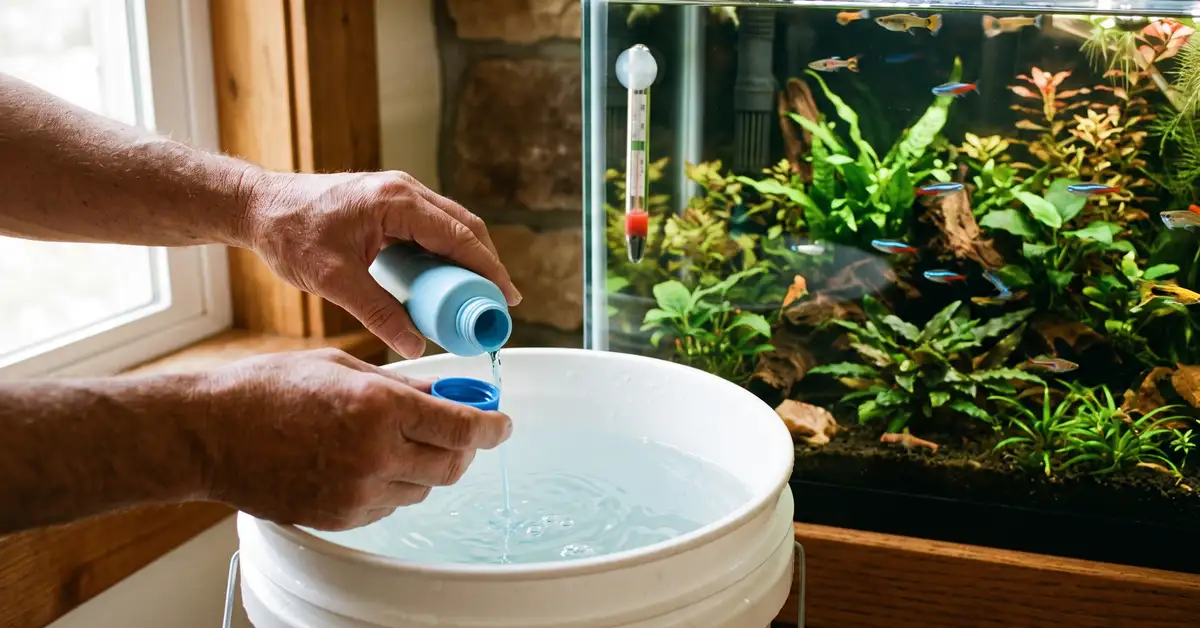
Fill a clean bucket with tap water and check it against the tank with a thermometer — aim to stay within a degree or two, since a bigger swing can shock fish and is a recognized trigger for stress-related illness. Add your dechlorinator at the dose stated on the label before this water reaches the tank; US tap water almost always carries chlorine or chloramine, both of which are toxic to fish and lethal to the nitrifying bacteria in your filter and substrate (see our best water conditioners guide for picks).
6. Refill slowly and restore power
Pour the treated, temperature-matched water back in slowly — down the glass or over a plate/decoration rather than directly onto substrate or fish, to avoid disturbing the tank or your gravel-vac work. Once refilled, plug the heater and filter back in and confirm both are running normally.
7. Retest and log the date
A quick ammonia/nitrite check an hour or two later confirms nothing was disturbed badly, and logging the date (a notebook, phone note, or app) makes it easy to notice if nitrate is creeping up faster than your current schedule handles — the signal to shorten your interval or increase your percentage next time.
Where aquarists genuinely disagree
Not everyone agrees on exactly how dangerous nitrate is. Mainstream aquarist educators generally recommend keeping nitrate under roughly 80-100 ppm (lower for sensitive or planted setups), while a minority, more contrarian view argues nitrate is far less harmful than commonly assumed and that changes are only strictly necessary once it climbs well past that range. We side with the more conservative, mainstream guidance for a beginner-friendly routine — the downside of changing water “too often” is minimal, while the downside of letting nitrate run high in an unmonitored tank is not. If you want the deeper dive into bringing an already-high reading down quickly, see our guide to lowering nitrates.
Common water-change mistakes
- Skipping the dechlorinator “just this once.” Every fill and every water change needs it — chlorine and chloramine don’t announce themselves before they damage gills and bacteria.
- Vacuuming the entire substrate every time. Clean it in rotating sections instead; stripping it all at once can set your cycle back.
- Pouring in water that isn’t temperature-matched. Trust a thermometer, not your hand — a few degrees’ difference is enough to stress fish.
- Leaving the heater running while the tank drains. Unplug it before you start; an exposed heating element is a crack and shock risk.
- Sticking to a fixed calendar during a fish-in cycle. Let ammonia and nitrite readings set the schedule until the cycle completes, not the day of the week.
Frequently Asked Questions
General information only — not veterinary advice. If your fish show ongoing signs of stress or illness, consult an aquatic veterinarian.
Sources: Aqueon: Why Is the Nitrogen Cycle Important for a Healthy Fish Tank? · Aquarium Co-Op: Is Nitrate Good or Bad for Your Aquarium? · PetMD: 30-Day Guide to Help Your New Pet Fish Thrive · Aquarium Science: Aquarium Water Change Math